Mini Dental Implants Cost vs Standard Implants
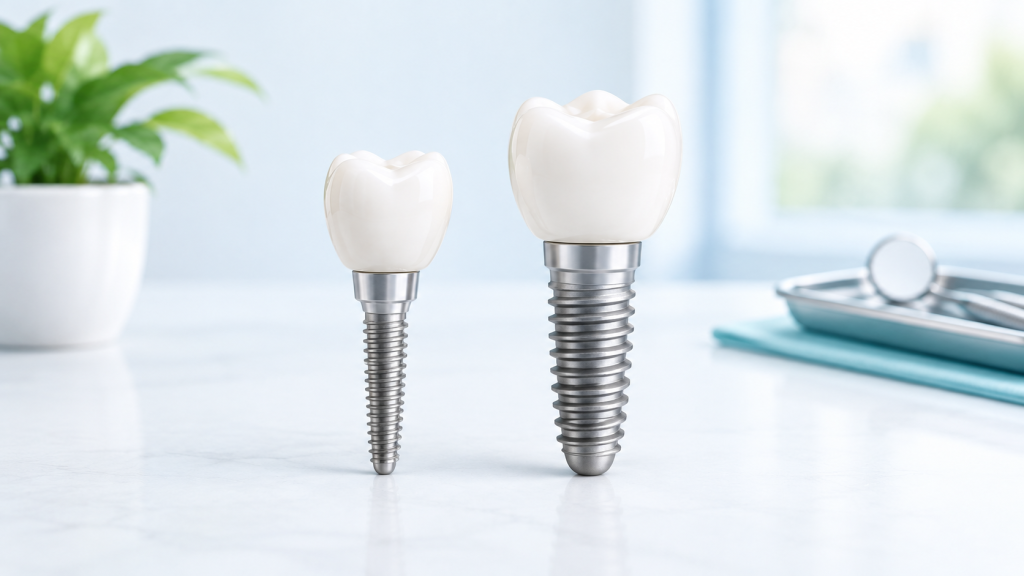
Set a toothpick next to a standard pencil and you’ve basically got the size difference between a mini dental implant and a standard one. That gap in diameter, often less than 3 millimeters versus 3.5 to 6 millimeters, sounds minor on paper, but it changes almost everything about the procedure: what you’ll pay, how it’s placed, and whose mouth it’s actually suited for.
This guide breaks down what separates the two, what each one costs, and where the research actually stands on which lasts longer.
Quick Answer
Mini dental implants typically cost $500 to $1,500 per implant, while a standard implant runs $3,000 to $6,000 for the post, abutment, and crown combined. The lower mini implant price reflects a smaller, simpler, often one-piece design placed with less invasive surgery. Standard implants remain the preferred choice for replacing a single tooth under normal chewing forces, while mini implants are most often used to stabilize a lower denture or in patients with narrow bone that can’t support a standard-width implant.
At a Glance
| Mini Dental Implants | Standard Implants | |
|---|---|---|
| Diameter | Under 3 mm (commonly 1.8 to 3.3 mm) | 3.4 to 6 mm |
| Design | Usually one-piece | Two-piece, with a separate abutment |
| Typical cost, per implant | $500 to $1,500 | $3,000 to $6,000 (post, abutment, crown) |
| Surgery | Minimally invasive, often no flap or sutures | More involved, sometimes needs bone grafting |
| Most common use | Denture stabilization, narrow ridges | Single-tooth replacement, fixed bridges |
| FDA status | Cleared for long-term use since 1997 | Decades-long established standard of care |
What Actually Separates the Two
The defining difference is width. A mini dental implant, sometimes called a narrow-diameter implant, measures under 3 millimeters across, while a standard implant runs anywhere from 3.4 to 6 millimeters. The FDA cleared mini implants for long-term use back in 1997, not as an experimental shortcut but as a genuine, approved option in its own right.
Design matters just as much as size. Most mini implants are a single solid piece, with the post and the small ball-shaped attachment built as one unit. Standard implants are typically two pieces: the implant post goes into the bone first, and a separate abutment connects it to the crown afterward. That two-piece setup gives a standard implant more components, more lab work, and more clinical steps, which is a big part of where its higher price comes from.
Why the Price Gap Is So Large
The savings on a mini implant come from the procedure being genuinely less involved at nearly every step, not from cut corners. Placement is often a single, minimally invasive visit without cutting and stitching a gum flap, which cuts down on chair time and surgical fees. The one-piece design skips the lab work needed to fabricate and fit a separate abutment. And because mini implants need less bone to begin with, many patients avoid a bone graft altogether, a cost that can otherwise add anywhere from a few hundred to several thousand dollars onto a standard implant case, something we cover in detail in our bone graft cost by graft type guide.
For patients using mini implants to stabilize a full lower denture, which typically calls for four implants, total cost commonly lands between $2,000 and $5,000, well under what the same stabilization would cost with standard implants and a full overdenture setup, which we break down separately in our implant-supported overdentures cost guide.
What the Research Actually Shows
This is the part worth reading carefully before assuming “cheaper” means “worse.” A randomized controlled trial published in BDJ Open in 2025 compared standard implants against two diameters of mini implants, all supporting a lower denture, over 18 months. Survival came out identical across all three groups at 100 percent. Success rates sat close together too: 90.91 percent for standard implants, 90.63 percent for 3mm mini implants, and 90 percent for 2.5mm mini implants, differences small enough that the trial’s authors didn’t consider them clinically meaningful.
A broader meta-analysis pooling multiple studies tells a slightly more nuanced story. It found average survival rates of 98 percent for both mini and narrow-diameter implants, essentially tied, but average success rates of 93 percent for mini implants against 96 percent for narrow-diameter implants, a modest edge for the wider option over longer follow-up periods. The takeaway isn’t that one option is clearly superior. It’s that short-term outcomes look genuinely comparable, while the gap, where one exists at all, tends to show up gradually, over years rather than months.
When a Mini Implant Actually Makes Sense
Mini implants tend to fit a specific set of situations rather than serving as a universal budget alternative. They’re a strong fit when a patient needs to stabilize a lower denture without committing to a full standard-implant overdenture, when the jawbone is too narrow for a standard implant and the patient wants to avoid a bone graft, or when a patient’s overall health makes a longer, more invasive surgery a bigger risk than the dental benefit justifies. They’re generally not the first choice for replacing a single molar that will take the full force of daily chewing, since their reduced width means less surface area anchoring them in bone.
When a Standard Implant Is Still the Better Call
A standard implant stays the usual recommendation for a single back tooth carrying normal bite force, or for a fixed bridge replacing several teeth in a row, a role it’s held through decades of documented clinical use. Its two-piece design also gives your dentist more flexibility to correct the angle of the crown separately from the implant itself, which matters more than it sounds like for getting a natural-looking, properly aligned result.
A Word on “Cheaper Now” vs. “Cheaper Over Time”
A mini implant’s lower sticker price is real, but it’s worth asking your dentist directly how it applies to your specific case, not just your budget. For denture stabilization, the short-term data above suggests mini implants hold up genuinely well. For replacing a single tooth under heavy chewing load, the slightly lower long-term success rates seen in some studies are worth weighing against the upfront savings, since a failed implant that needs to be replaced later erases most of what you saved to begin with. This is exactly the kind of trade-off a consultation and imaging can clarify for your own bone and bite, far better than a general comparison can.
Paying for Either Option
Whichever option fits your case, our dental implant financing calculator and dental implant insurance calculator can help you plan the real cost, and if you have an HSA or FSA, our guide to using those funds for implants explains what typically qualifies.
See Your Own Numbers
Our dental implants cost calculator lets you model either approach against your specific treatment plan.
Frequently Asked Questions
Are mini dental implants a cheaper version of the same thing, or genuinely different?
Genuinely different. They’re smaller, often one-piece rather than two-piece, and suited to a different set of clinical situations, not simply a budget substitute for a standard implant.
Do mini implants fail more often than standard implants?
Short-term randomized trial data shows comparable survival between the two. Some longer-term meta-analyses show a modest edge for standard-width implants on success rate specifically, though both options perform well overall.
Can mini implants replace a single back tooth?
It’s possible but less common, since their narrower width offers less surface area to handle heavy chewing forces. Standard implants remain the more typical choice for a single molar.
Do mini implants require a bone graft?
Usually not, which is one of their main advantages. Their smaller size often allows placement in narrower bone that wouldn’t support a standard implant without grafting first.
How much do mini implants cost for a full lower denture?
Stabilizing a lower denture typically requires four mini implants, commonly totaling $2,000 to $5,000, compared to a considerably higher cost for the same stabilization with standard implants.
Is the FDA approval for mini implants the same as for standard implants?
Mini implants received FDA clearance for long-term use in 1997 and are a fully approved option, not an experimental or temporary one, though the two implant types are evaluated and cleared separately given their different designs.
The Bottom Line
Mini and standard implants aren’t competing versions of the same product, they’re different tools built for different jobs. Mini implants cost significantly less and perform well for denture stabilization and narrow-bone cases, while standard implants remain the better-established choice for single-tooth replacement under normal chewing load. The right one for you depends on your bone, your bite, and what you’re actually replacing, which is exactly what a consultation and imaging are for.
Sources: FDA mini implant approval history, PMC systematic review · Randomized controlled trial, standard vs. mini implants, BDJ Open 2025, via PMC · Meta-analysis of mini and narrow-diameter implant survival and success rates, scite.ai