Implant-Supported Overdentures (Overdentures) Cost: The Price Nobody Finishes Explaining
By Dr.Mike, BDS, MDS – Dentist & Oral Health Specialist
Most patients walk out of a consultation with one number in their head: what the overdenture will cost to place. Almost nobody walks out with the second number, what it will cost to keep running over the years that follow. Several research teams have tracked that second figure closely, and more than one found that the upkeep bill, added up over five to seven years, can quietly catch up to the original treatment cost. None of this is a reason to rule overdentures out. It’s a reason to plan for both numbers from the start instead of being surprised by the second one later.
Quick Answer
An implant-supported overdenture generally has an initial cost of about $7,628 to $13,297 per arch. This upfront amount typically includes the implants, attachment components, and the overdenture itself. However, the long-term cost does not end with placement. Published studies report widely varying maintenance expenses over a five- to seven-year period, ranging from around 10% to more than 50% of the original treatment cost, depending on the attachment system and the findings of each study. For this reason, it is important to budget for ongoing maintenance in addition to the initial placement cost.
At a Glance
| Typical figure | |
|---|---|
| Upfront cost, per arch | $7,628 to $13,297 |
| Upfront cost, both arches | $38,000 to $62,000 |
| Reported 5 to 7-year maintenance cost | Roughly 10% to 55%+ of the initial cost, depending on the study and attachment type |
| Single attachment replacement (ball/O-ring) | Commonly $50 to $150 |
| Single attachment replacement (Locator) | Commonly $100 to $250 |
| Denture reline | Typically every 3 to 5 years |
What an Implant-Supported Overdenture Actually Is
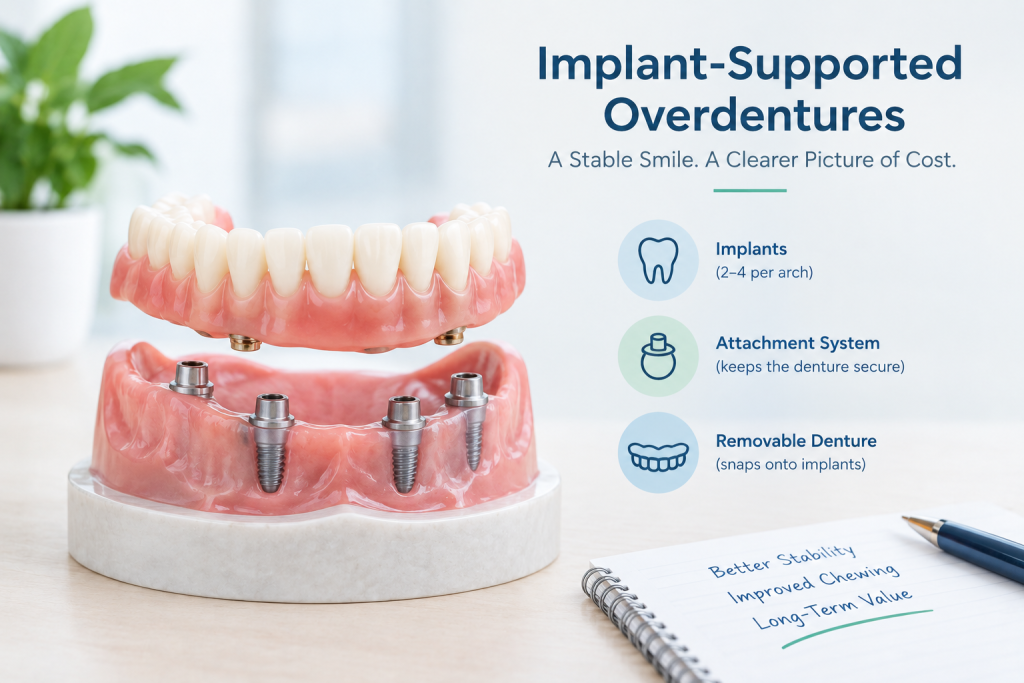
Picture two to four small implants anchored in the jawbone, usually per arch, with a removable denture that clicks onto them rather than resting loosely on the gums the way a conventional denture does. That click is the whole point. It turns a prosthesis that shifts when you bite into one that stays put, without going as far as a permanently fixed bridge like All-on-4. The trade-off for that extra stability is a mechanical connector doing real work every day, and like any mechanical part under daily load, it eventually wears and needs attention.
Pricing the Treatment Itself
According to CareCredit’s national cost study, the average price for this treatment sits at $8,289 per arch, with most patients landing somewhere between $7,628 and $13,297. Treating both arches roughly doubles that, putting a complete set in the $38,000 to $62,000 range. To see how that compares against a conventional denture on one end and a fixed All-on-4 bridge on the other, our full mouth dental implants cost guide lines up all three side by side.
Three Ways to Attach the Denture, Three Different Cost Personalities
The implants only do half the job. What the denture clips onto matters just as much to your long-term spending.
| Attachment | How it works | Maintenance pattern | Typical use |
|---|---|---|---|
| Ball (O-ring) | A rounded stud seats into a rubber-lined socket | Shows up often, cheap to fix each time | Straightforward cases, patients comfortable handling small parts |
| Locator | A low-profile nylon insert self-corrects for minor angle mismatches | Less frequent than ball, moderate cost per visit | The default choice in most practices today |
| Bar | A milled metal bar joins the implants, and the denture clips onto the bar itself | Costs more to build, tends to hold up longest | Thinner bone, or patients chasing maximum stability |
A 2019 comparison of all three systems found bar-retained overdentures outperformed the other two on both holding power and preserving bone around the implants, though building a bar costs more upfront than either stud-style option. Locator attachments have become the everyday default largely because they cost less to start with and are simpler to keep clean around.
The Bill That Arrives After the Treatment Is Already Done
This is the section worth reading slowly before you pick an attachment. Researchers at the University of Colorado School of Dental Medicine pulled records for 75 patients wearing Locator-retained overdentures and watched their maintenance visits unfold over an average of five years and change. Replacing the attachment components was the most frequent reason for follow-up care, affecting approximately 60% of the patients included in the study. Tallied up, the dollars spent on upkeep averaged a little over half of what the original treatment had cost, close to $795 on top of the initial bill. The researchers didn’t soften their own conclusion: by year five, keeping the denture working had cost patients about as much as building it had in the first place, sometimes more.
Not every study lands in the same place, though. A separate seven-year study put upkeep closer to one-fifth of the original cost, with ball and Locator attachments running neck and neck rather than one clearly beating the other. Yet another, following patients for up to eight years, found maintenance settling around one-tenth of the initial treatment price, again with little daylight between attachment types.
Why such a wide spread across three legitimate studies? Different patient groups, different recall schedules, different local pricing, and different judgment calls about what counts as “maintenance” versus a routine checkup all pull the numbers in different directions. The one thing every study agrees on is that this cost is real and recurring, not a rare exception you can safely ignore while budgeting. Treat it as a line item from day one rather than a bill that blindsides you at a future cleaning.
For a rough sense of what that looks like at the chair, long-running clinical discussion boards like Osseo News show patients commonly reporting $50 to $150 to swap out a single ball attachment, a bit more for Locator housings, with most needing this done somewhere between once a year and once every two years per attachment, plus a full reline of the denture base roughly every three to five years.
How Many Implants Does Your Case Actually Need
Two implants per arch covers the baseline for a stable overdenture, and that’s often enough in the lower jaw, where bone tends to be denser. The upper jaw frequently asks for more, sometimes reaching four, because maxillary bone is generally softer and chewing forces move through it differently. Adding implants tends to improve stability and can extend how long the restoration holds up, but it also raises the starting price and adds more attachment points that could eventually need servicing. This particular number comes out of your own scan and exam, not a rule of thumb to apply in advance.
Insurance and Paying for It
Coverage for this treatment swings widely from one dental plan to the next, and even generous plans tend to cap out well below the actual cost. Ask your insurer directly whether overdentures fall under their prosthodontic benefit, and get a pre-treatment estimate in writing before anything is scheduled. Our dental implant insurance calculator and dental implant financing calculator can help you model the upfront number alongside a realistic cushion for maintenance.
Overdenture or Fixed Bridge: A Fast Gut Check
An overdenture tends to fit patients who want a clear upgrade over a conventional denture without stretching to the top price tier, whose bone supports a smaller implant count comfortably, and who don’t mind a removable piece and occasional attachment servicing. A fixed All-on-4 or All-on-6 bridge fits better when a permanent, non-removable result outweighs the lower starting price, since a fixed bridge sidesteps this entire category of recurring attachment cost. Our full mouth dental implants cost guide walks through that fuller comparison.
Questions Worth Asking Before You Pick an Attachment
- Which attachment system do you recommend for my specific case, and what’s driving that recommendation?
- In your own patients, roughly how often does this system need a part replaced?
- What does one attachment replacement cost at this office?
- Is a reline ever covered under a warranty, or is it always billed separately when it comes up?
See Your Own Numbers
Our full mouth dental implant cost calculator lets you set an overdenture side by side against the other full-arch routes.
Frequently Asked Questions
Is an implant-supported overdenture the same thing as All-on-4?
No. An overdenture comes out for cleaning and clips onto a smaller number of implants. All-on-4 stays fixed in place, removable only by a dentist, and is generally built on four implants placed in a specific layout.
Which attachment ends up cheapest over time?
No single study settles this. Bar systems cost more to build but may ask less of you later. Ball and Locator cost less upfront, and research is genuinely split on which one demands more attention down the road. Your own dentist’s chairside experience is worth asking about directly.
Can I switch attachment types later if I’m unhappy with the upkeep?
Often, yes, and it’s a fairly common upgrade path, though it comes with its own cost. Check with your prosthodontist whether your existing implants can accept a different attachment.
Does the bar system really need less maintenance than ball or Locator?
The research points to stronger retention and better bone preservation with bar systems, but “less maintenance” specifically isn’t a guarantee across every study. The clearer trade-off is simply a higher cost to build it.
Realistically, how often will I be back in the chair for this?
Patient-reported experience commonly lands around once every one to two years per attachment for ball and Locator systems, though your own chewing habits, bite force and the specific hardware used all shift that timeline.
Does insurance ever pick up part of the maintenance cost?
Sometimes, partially, depending on how your plan defines its prosthodontic benefit. Worth confirming directly, since plenty of patients assume upkeep rides along with the original treatment cost when it often doesn’t.
The Bottom Line
An implant-supported overdenture carries two price tags, not one: what you pay to have it placed, and what you’ll keep paying, in smaller amounts, to keep it functioning well. Budget for both from the outset, ask your own provider what their patients typically spend on upkeep, and weigh that full picture against a fixed full-arch option before deciding. Our full mouth dental implant cost calculator is a reasonable place to start running those numbers.
Sources: CareCredit, Dental Implants Cost and Procedure Guide, 2024 Synchrony Average Procedural Cost Study, ASQ360° Market Research · University of Colorado School of Dental Medicine, retrospective maintenance cost study, PubMed · Ball, bar and locator attachment comparison, PMC · Seven and eight-year maintenance cost studies, MDPI and Preprints.org · Patient-reported attachment replacement costs, Osseo News community