
Snap In Dentures: How They Work and Who They’re For
Twenty years ago, the standard advice for an edentulous lower jaw was simply “here’s your denture, get used to it.” That’s genuinely no longer the professional consensus. A panel of prosthodontists meeting at McGill University decided otherwise back in 2002, and most of the field has agreed with them since. Snap-in dentures are the reason why.c
Quick Answer
A snap-in denture, also called an implant-retained overdenture, is a removable denture that clips onto 2 to 4 implants anchored in the jawbone, instead of relying on suction and adhesive. It stays locked in place during eating and talking but comes out nightly for cleaning. A 2002 expert panel at McGill University reviewed the evidence and moved away from the old default of a conventional denture for a toothless lower jaw, naming a two-implant overdenture the better starting point instead.
At a Glance
| Detail | |
|---|---|
| Other names | Snap-on dentures, implant-retained overdenture, implant-supported denture |
| Implants needed, lower jaw | 2 to 4 |
| Implants needed, upper jaw | 4 minimum, sometimes more |
| Removable by patient | Yes, typically nightly |
| Main attachment types | Locator, bar-clip, ball |
| Clinical consensus | McGill (2002) and York (2009) statements both favor it over conventional dentures |
The Clinical Consensus Behind This, Not Just Marketing
I want to start here because it matters more than the mechanics. In 2002, a panel of experts convened at McGill University and concluded that a two-implant overdenture should become the first choice of treatment for the edentulous mandible, rather than a conventional denture. A follow-up panel in 2009, known as the York Consensus Statement, reviewed the accumulated evidence since and confirmed that patient satisfaction and quality of life with implant-retained overdentures were significantly greater than with conventional dentures. This isn’t a single study or a clinic’s opinion. It’s two separate expert panels, seven years apart, independently reaching the same conclusion.
How the Clip Mechanism Actually Works
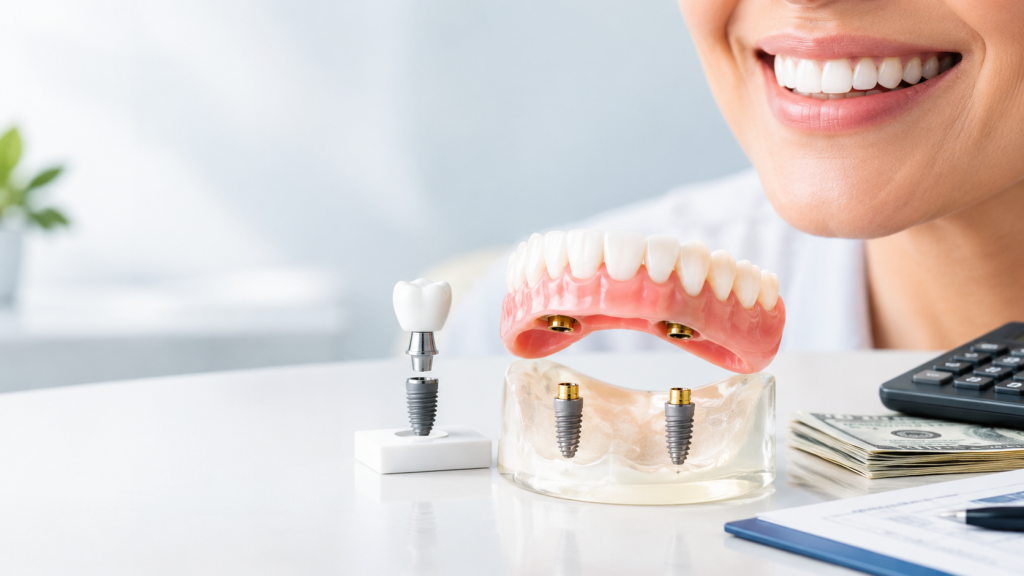
A conventional denture stays in place through suction and the shape of your gum ridge, which is exactly why it loosens as the ridge changes shape over the years. A snap-in denture solves this differently. Small attachment components sit on top of implants placed in the jawbone, and matching housings are built into the underside of the denture. Press the denture into place and it clicks firmly onto the implants, similar to how a jacket snap closes. It stays locked during normal chewing and speaking, and you release it yourself with gentle pressure to remove it for cleaning, typically each night.
Three attachment systems handle this connection. Locator attachments are the most common choice today, low-profile and self-aligning, which makes them forgiving if the implants aren’t placed at perfectly matched angles. Bar-clip systems connect two or more implants with a milled metal bar before the denture clips onto the bar itself, offering more retention at a higher lab cost. Ball attachments were an earlier standard and still work, but most practitioners, myself included, now default to locators for new cases due to their lower maintenance demands.
Why the Lower and Upper Jaw Need Different Numbers of Implants
The lower jaw typically needs just 2 to 4 implants, usually placed in the canine region where bone is densest. This is where a conventional denture struggles most, since the narrow, horseshoe-shaped ridge offers minimal suction and the tongue constantly pushes against it. Treating the upper jaw asks more of the plan. Maxillary bone tends to be softer and less dense than the lower jaw’s, and gravity pulls an upper denture downward, away from the palate, rather than helping it stay seated. For both reasons, bar-clip attachments see more use up top, and upper cases typically need a minimum of four implants, sometimes more depending on bone density. One genuine upside worth knowing: with enough implant support, the denture’s palate coverage can often be reduced or removed entirely, which matters because full palate coverage on a conventional upper denture can dull taste and trigger gagging in some patients.
What the Research Actually Shows on Chewing
Beyond patient-reported comfort, there’s measurable function data here. One clinical trial tracking patients who switched from conventional dentures to a two-implant overdenture found that food particle size after chewing dropped to 76.34 percent of what it had been with conventional dentures, meaning food was broken down considerably more effectively, and patients needed only 40 chewing strokes to reach the same consistency that took 69 strokes with a conventional denture. That’s a meaningful, measurable jump in chewing efficiency, not just a subjective “feels better.”
Snap-In Dentures vs. Conventional Dentures vs. Fixed All-on-4
| Conventional Denture | Snap-In Denture | Fixed All-on-4 | |
|---|---|---|---|
| How it stays in | Suction and adhesive | Clips onto 2 to 4 implants | Screwed onto 4 to 6 implants |
| Removable by patient | Yes | Yes, nightly | No |
| Stability during eating | Lowest | Good to very good | Highest |
| Adhesive needed | Usually | No | No |
| Where it fits in cost | Lowest | Middle | Highest |
For the actual dollar ranges across all three options, our implant-supported overdentures cost guide breaks down pricing in detail, including the attachment-replacement maintenance costs that don’t show up in the upfront quote.
Who Tends to Do Well With a Snap-In Denture
In my experience, three patient types benefit the most. Longtime denture wearers who are frustrated with slipping, clicking, or a constant reliance on adhesive paste usually feel the difference immediately. Patients who like the idea of implant-level stability but specifically don’t want a permanently fixed prosthesis, because they prefer removing it at night and letting the tissue rest, are a strong fit by design. And patients who have enough bone for 2 to 4 implants but not quite enough, or budget, for a full fixed bridge find this sits in a genuinely useful middle ground rather than a compromise.
What You’re Actually Signing Up for Long-Term
A snap-in denture isn’t maintenance-free, and it’s worth knowing that going in rather than discovering it later. The attachment inserts wear down with regular use and need periodic replacement, the denture base itself typically needs relining every few years as the gum tissue beneath it changes shape, and the acrylic denture has a finite working life before it eventually needs remaking. None of this is a flaw in the system, it’s simply the nature of a removable prosthesis working against implants day after day. Our implant-supported overdentures cost guide goes deep on what this maintenance actually costs over time, since it’s a real part of the total picture most patients don’t think to ask about upfront.
Model Your Own Numbers
Our dental implants cost calculator and dental implant financing calculator can help you compare a snap-in denture against both a conventional denture and a fixed bridge for your specific case.
Frequently Asked Questions
Is a snap-in denture the same as a snap-on denture?
Yes, these are two names for the identical treatment. Some patients say “snap-in” for the daily motion of inserting it, others say “snap-on” for the attachment mechanism itself. Both refer to a removable denture that clips onto implants.
Can my current denture be converted into a snap-in denture?
Often, yes, if it’s in good condition and fits reasonably well. A dentist can retrofit it with attachment housings once the implants have healed, which is usually faster and less expensive than building a new denture from scratch.
How is this different from a fixed All-on-4 bridge?
A snap-in denture is removable, clips onto fewer implants, generally costs less, and you take it out yourself nightly. A fixed bridge is permanently screwed in place, only removable by a dentist, and uses more implants for a more tooth-like, non-removable result.
Do I need implants in both jaws for this to work?
No, many patients choose a snap-in denture for the lower jaw specifically, since that’s where conventional dentures struggle most, while keeping a conventional or different solution on top.
Is the two-implant option really considered a best practice, or a budget compromise?
It’s genuinely the former. Both the McGill and York consensus statements describe a two-implant lower overdenture as the appropriate first-choice standard of care, not a lesser fallback option.
Will eating feel completely normal again?
Most patients regain a significant amount of function and can eat foods that were difficult or impossible with a conventional denture. Very hard or sticky foods are still worth approaching carefully to protect the attachments.
The Bottom Line
A snap-in denture sits in a genuinely useful middle ground: considerably more stable than a conventional denture, removable and generally less expensive than a fixed bridge, and backed by two independent expert panels concluding it should be the standard of care, not a compromise. Whether it fits your own bone, budget, and preference for removable versus fixed is worth a real consultation and imaging to confirm. Our dental implants cost calculator is a solid place to start comparing your options before that appointment.
Sources: The McGill Consensus Statement on Overdentures, 2002, and the York Consensus Statement, 2009 · Chewing efficiency and patient satisfaction, conventional denture vs. implant-retained overdenture, PMC