
Save the Tooth or Extract: Root Canal Plus Crown vs Implant Cost
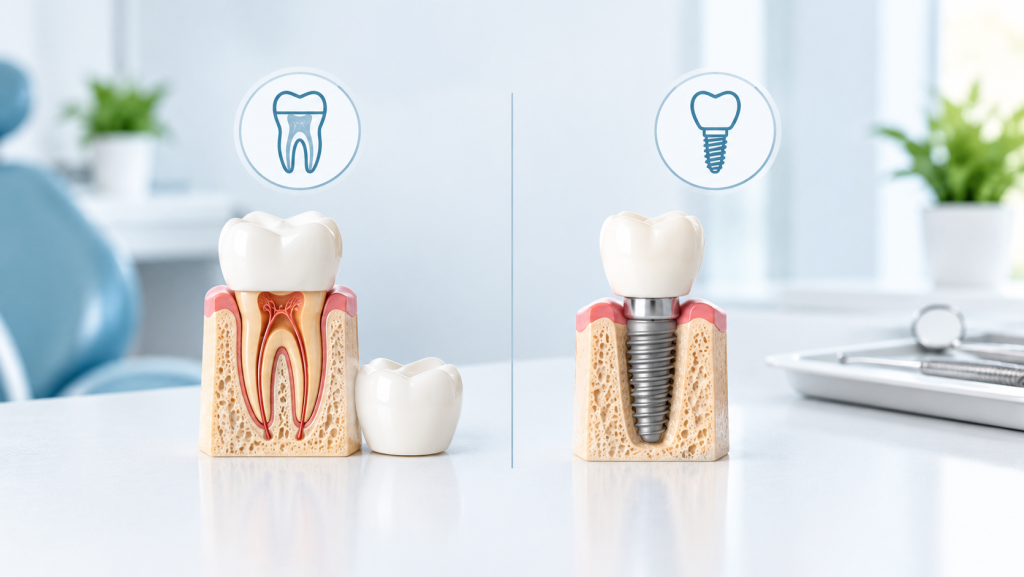
Many patients sit in the dental chair and hear that their tooth might be saved, or that it might need to come out and be replaced with an implant. They then have to decide quickly. It sounds like a budget question: spend less now and keep the tooth, or spend more and get an implant. But each path has its own track record, and the option that costs less today can end up costing more over .
Quick Answer
Expect to pay roughly $1,600 to $3,500 for a root canal and crown combined. Removing the tooth and placing an implant with its abutment and crown usually lands between $3,000 and $6,000 or higher, because the extraction fee is added on top. In large studies, around 86% of root canal-treated teeth were still in the mouth after a decade. Implants are generally reported at about 90% to 95% over that same period. Neither option suits every tooth, and the clinical condition of the tooth usually matters more than the price.
Side-by-Side Comparison
| Root Canal + Crown | Extraction + Implant | |
|---|---|---|
| Typical total cost | $1,600 to $3,500 | $3,000 to $6,000+ |
| What you pay for | Root canal and crown | Extraction, implant post, abutment, and crown |
| Keeps your natural tooth | Yes | No |
| 10-year survival (large studies) | About 86% | Roughly 90% to 95% |
| Number of visits | Usually 2 to 3 | Usually 3 to 10, spread over several months |
| Insurance | Often covered as basic or major care | Often excluded or capped at a low limit |
What Each Route Costs
CareCredit’s national figures show a root canal ranging from $679 to $1,733, depending on the tooth. A crown adds $697 to $1,399. Added together, most patients pay somewhere between $1,600 and $3,500. Molars sit at the upper end because they have more canals that need cleaning.
An implant starts with taking the tooth out. Extraction fees range from $177 to $2,685, depending on how difficult the removal is. The implant comes next. The post, abutment, and crown together usually cost $3,000 to $6,000, and our dental implants cost guide covers that in detail. If the socket needs a bone graft and time to heal before the implant can be placed, the overall bill often ends up higher than the root canal route.
Why Price Alone Does Not Tell the Whole Story
The two treatments wear differently over time. One large study analyzed nearly half a million root canal treatments through insurance claims. It found that 98% of the teeth survived the first year, 92% reached the 5-year mark, and 86% were still there at 10 years.
A separate study followed teeth for as long as 37 years. Survival was 97% at 10 years, 81% at 20 years, 76% at 30 years, and 68% at 37 years. Success rates, which only count teeth that stayed free of symptoms, were 93%, 85%, 81%, and 81% across those same periods.
Research on implants generally places 10-year survival at 90% to 95%. That is close to what root canal-treated teeth achieve, not far ahead of it. A well-done root canal on a suitable tooth is not a stopgap. Follow-up studies now cover several decades, and many treated teeth are still working normally after all that time.
Why the Crown Matters
During a root canal, the dentist clears out the nerve tissue and empties the inner chamber so the tooth can be disinfected and sealed. This leaves the remaining tooth weaker. If no crown is placed, everyday chewing can crack it. The American Association of Endodontists recommends a crown for nearly every back tooth after this procedure.
The timing of the crown matters too. Leaving a long gap between the root canal and the final crown lowers the tooth’s chances of lasting. One study followed root canal-treated teeth from the date the final crown was placed. When the crown was added promptly, survival reached 99.1% at 1 year, 96% at 3 years, and 92.3% at 5 years. The same research linked late crown placement to poorer results. If you choose to keep your tooth, schedule the crown as part of the same treatment plan instead of putting it off.
When Keeping Your Natural Tooth Is the Smarter Move
Saving the tooth is usually the better path when there is enough sound tooth left to anchor a crown, when any crack stays at or near the gumline, and when the surrounding bone and gum tissue are in decent shape. A crack does not automatically mean the tooth is lost, and plenty of cracked teeth respond well to a root canal. One study reported an 82.9% success rate for cracked teeth treated with a root canal, as long as the crack had not caused deep gum and bone damage.
When an Implant Is the Stronger Option
An implant becomes more appealing if the tooth has broken below the gumline, if gum disease has weakened the bone that holds it, or if too little natural tooth remains for a crown to hold onto. In the same cracked-tooth research, teeth with a deep crack and gum pockets of 5 millimeters or more did far worse, with success falling to about a third. When that happens, an implant usually gives a more predictable result than another attempt to hold onto a tooth that is failing.
Extra Costs People Often Forget
When a root canal fails, the dentist can sometimes redo the treatment instead of removing the tooth. Retreatment adds to the total, but it may still cost less than an extraction and implant. It does not always work, and it is not suitable for every kind of failure.
On the implant side, a bone graft is a common add-on when the socket must heal and rebuild before the implant is placed. You can see how prices differ for each graft material in our bone graft cost guide. The gap between extraction and the final implant crown can also run several months, which is a lot longer than a couple of visits.
How Insurance Affects the Final Bill
Most dental plans classify root canals and crowns as basic or major restorative care, so they usually cover part of the cost. Implants are often excluded or limited by a low annual maximum. Our guides on whether Medicare or Medicaid covers dental implants and on dental implants without insurance explain this further. Because of this coverage gap, the real difference in what you pay can be bigger than the listed prices suggest.
Run the Numbers for Yourself
If you are leaning toward an implant, our dental implant financing calculator and dental implant insurance calculator can help you plan. For a one-tooth replacement, try the single tooth implant cost calculator. Our full dental implants cost calculator also lets you compare different scenarios side by side.
Frequently Asked Questions
Is a root canal always cheaper than an implant?
At the start, usually yes. A root canal with a crown commonly adds up to $1,600 to $3,500, while an extraction with a complete implant often runs $3,000 to $6,000 or more. See our dental implants cost guide for a full breakdown of the implant side.
Does a lower price mean the tooth will not last as long?
No. Large studies show root canal-treated teeth surviving at rates from the high 80s to the low 90s percent through 10 years, which is broadly similar to implant survival over the same time.
What decides whether my tooth can be saved?
Mainly how much healthy tooth remains and how far any crack or infection has spread, especially if it reaches below the gumline or into the bone. Your dentist will assess this through an exam and imaging.
Can it ever make sense to remove a tooth that could technically be saved?
Yes, sometimes. If the odds are poor and the root canal would probably fail and lead to retreatment or extraction later, an implant from the start can be the better choice. Your dentist can explain the outlook for your own tooth.
What if a root canal fails later on?
Retreatment is often an option and may cost less than extraction and an implant. It is not guaranteed to work, and the result depends on why the first treatment failed.
Does insurance usually favor saving the tooth?
Generally, yes. Most plans pay toward root canals and crowns as standard restorative care, while implants are often excluded or capped at a low annual benefit. Our dental implant insurance calculator shows what you might pay out of pocket.
The Bottom Line
A root canal with a crown and an extraction with an implant are not simply the budget choice and the premium choice. Their long-term survival numbers are similar, and the right pick depends far more on the health of your tooth than on the price. At your appointment, ask your dentist about the outlook for your specific tooth, not only what each option costs. If extraction turns out to be the better route, use our dental implants cost calculator to plan your budget.