
Bone Graft Cost by Graft Type: What Drives the Price
A patient once asked why her sister paid $700 for a bone graft while she was quoted $4,500 for what sounded like the same thing. It was not the same thing. Her sister had a small graft placed in an empty tooth socket. She needed a sinus lift using bone harvested from her own hip. Same word, two completely different operations, two completely different bills.
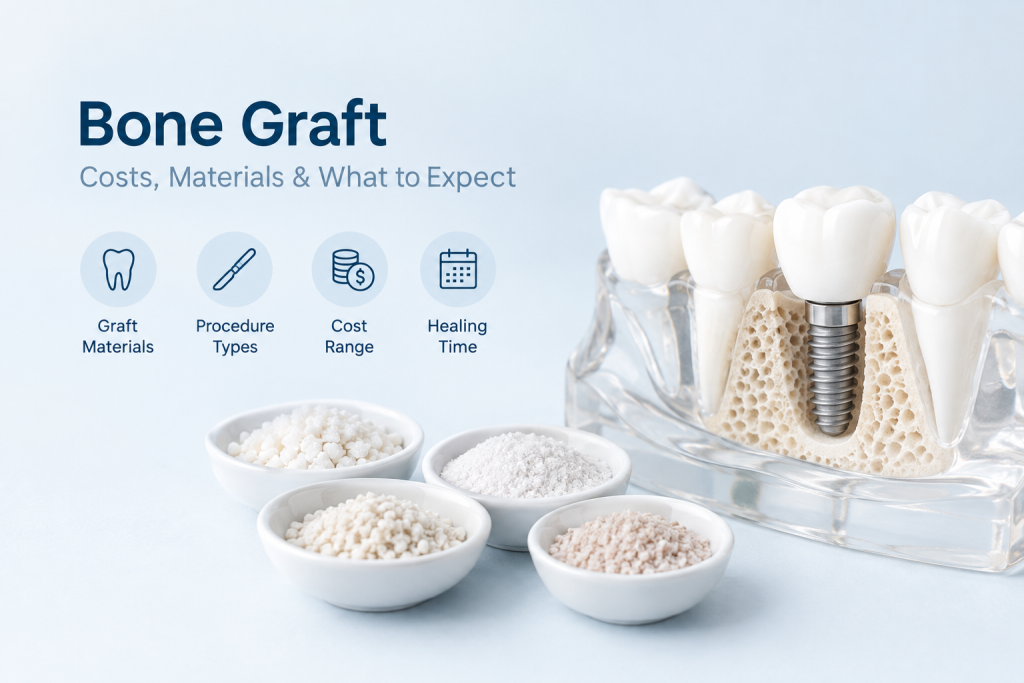
“Bone graft” is really an umbrella term. The price depends on two separate questions: what material goes into the graft, and what procedure is being performed. This guide answers both, using published fee data rather than guesswork, so you can read your own quote with more confidence.
Quick Answer
A simple graft placed at the time of a tooth extraction typically runs about $680 to $1,790. A sinus lift typically runs $1,470 to $3,860, with the lateral window technique costing more than the crestal technique. Material alone, separate from the surgery, ranges from roughly $550 for a synthetic or animal-derived graft to over $5,000 for a graft using your own bone.
At a Glance
| Graft type | Typical cost per graft |
|---|---|
| Xenograft (animal bone) | $549 to $1,386 |
| Alloplast (synthetic) | $576 to $1,375 |
| Allograft (donor bone) | $652 to $1,575 |
| Autograft (your own bone) | $2,161 to $5,148 |
| Procedure | National average |
|---|---|
| Socket or ridge preservation graft | $680 to $1,790 |
| Sinus lift, crestal approach | $600 to $1,500 |
| Sinus lift, lateral window | $2,000 to $4,000+ per side |
| Sinus lift, overall average | $1,470 to $3,860 |
Two Different Questions, One Confusing Word
When someone says “bone graft,” they could mean the material packed into the site, or they could mean the surgical procedure itself. Both affect price, and they move somewhat independently of each other. A small procedure using an expensive material can cost less than a large procedure using a cheap one. Reading a quote without separating these two variables is where most of the confusion starts.
Cost by Graft Material
Four materials cover almost every case.
Autograft. Bone taken from your own body, usually the chin, the back of the jaw, or the hip. This is the most expensive option because it requires a second surgical site, but it comes with living bone cells that some specialists prefer for larger defects. Typical cost: $2,161 to $5,148.
Allograft. Processed bone from a human tissue donor, screened and sterilized before use. It avoids the second surgical site, which keeps both the price and the recovery lighter. It is a frequent choice for socket grafts and moderate ridge rebuilding. Typical cost: $652 to $1,575.
Xenograft. Mineral bone structure from an animal source, most often cow bone, processed to remove the organic material. Your own bone gradually grows into this framework. It tends to resorb slowly, which some clinicians prefer for sites that will wait a while before an implant goes in. Typical cost: $549 to $1,386.
Alloplast. A fully synthetic material, commonly made from hydroxyapatite or beta-tricalcium phosphate. Nothing from a person or an animal is used, which some patients prefer on personal or religious grounds. It works well for smaller defects. Typical cost: $576 to $1,375.
Material cost figures: CareCredit, Dental Bone Graft Cost and Procedure Guide, based on a 2024 national procedural cost study.
Cost by Procedure
This is usually the bigger driver of your final bill. The same material costs more or less depending on what the surgeon actually does with it.
| Procedure | CDT code | National average | Contracted fee example |
|---|---|---|---|
| Socket or ridge preservation | D7953 | $680 to $1,790 | $267 |
| Ridge augmentation | D7950 | Billed by report | $1,409 |
| Sinus lift, lateral window | D7951 | $2,000 to $4,000+ per side | $2,835 |
| Sinus lift, crestal | D7952 | $600 to $1,500 | Not published |
Socket or ridge preservation (D7953) is the graft placed into a tooth socket right after extraction, to stop the surrounding bone from shrinking before an implant is planned. It is usually the least expensive and least invasive option on this list.
Ridge augmentation (D7950) rebuilds width or height in an area where bone has already shrunk, often used when someone is planning an implant well after losing a tooth. Because the defect size varies so much, this one is frequently billed “by report” rather than at a fixed fee.
Sinus lift, lateral window (D7951) lifts the floor of the sinus through a window cut in the side of the jawbone. It is the more invasive of the two sinus lift techniques and is used for larger bone shortages.
Sinus lift, crestal (D7952) lifts the sinus floor through the same channel the implant will eventually use, which makes it less invasive and usually less expensive than the lateral window approach, but it only works when a smaller lift is needed.
Procedure cost figures: national averages from Pearl, Bone Graft (Dental) National Cost and Pearl, Sinus Lift National Cost; contracted fee examples from the Delta Dental Patient Direct fee schedule effective November 2025, as reported by ThePricer.
A contracted insurance fee is not the same as a cash price. It reflects a negotiated rate between an insurer and a participating dentist, so it sits well below many out-of-pocket quotes. Use it as a floor, not an expectation.
A Worked Example: Both Sides of the Sinus
Here is how the numbers stack when more than one site is involved. Pearl’s data puts a single lateral sinus lift at $2,000 to $4,000 or more per side, and notes that treating both sides typically costs 1.5 to 2 times the single-side price because the surgical setup and diagnostics are shared. Multiplying that out gives a bilateral lateral sinus lift a rough range of $3,000 to $8,000, before the implants themselves are added. This is a calculation for illustration, not a quote, and your own number depends entirely on your anatomy.
What Moves Your Specific Quote
- Number of sites. Grafting is priced per site, so three areas in need of bone mean three separate charges.
- Barrier membrane. A membrane protects the graft while it heals. Some practices include it in the headline price, others bill it on its own.
- Imaging. A CBCT scan maps bone height and width in three dimensions before surgery. Confirm whether it appears as a separate line.
- Sedation level. Local anesthesia is standard. IV sedation or general anesthesia adds to the total.
- Who performs it. Oral surgeons, periodontists and general dentists price differently from one another, and so do different cities.
- Insurance coding. Some insurers reprocess a ridge augmentation claim under the lower-paying ridge preservation code. Ask your office which code it plans to submit before treatment.
How Long Before an Implant Can Follow
Healing time matters because it can delay your implant, which has its own cost implications if you are paying for temporary teeth in the meantime. Pearl’s clinical guidance puts bone integration, meaning the point where the graft is stable enough for an implant, at roughly 4 to 9 months, depending on the size of the graft and your individual healing. Larger sinus grafts tend to sit toward the longer end of that window. In some cases, your surgeon may place a smaller graft and the implant together in one visit, a decision that depends entirely on your scan.
Does Insurance Help?
Sometimes, and it depends heavily on why the graft is needed. According to Pearl, some dental plans pay roughly 40 to 50 percent of a sinus lift when it is classified as medically necessary, and medical insurance occasionally contributes after trauma or disease. A graft performed purely to prepare for an elective implant is more often treated as not covered. Ask your office for a pre-treatment estimate before surgery. It shows exactly what your plan will pay per procedure code, in writing, before you commit.
For a side-by-side look at how insurance and financing change your total, try our dental implant insurance calculator.
Is There a Way to Avoid Grafting Altogether?
Sometimes. When enough native bone remains, a surgeon may be able to use a shorter implant or angle it away from the sinus, avoiding a lift entirely. Whether either option applies to you depends entirely on your imaging, so this is a question for your surgeon rather than a general rule.
Ways to Manage the Cost Without Cutting Corners
- Ask for an itemized quote that separates the graft, the membrane, imaging and sedation.
- Ask whether a less expensive material would work for your specific defect.
- Request a written pre-treatment insurance estimate before surgery, not after.
- Ask about dental school clinics in your area, where supervised students sometimes charge less for the same procedures.
- Ask whether your office offers a payment plan for the portion insurance does not cover.
See Your Own Numbers
Material and procedure both feed into our bone graft cost calculator, and if a sinus lift is part of your plan, our sinus lift cost calculator breaks that out separately. Both give an educational estimate to bring to your consultation, not a binding price.
Frequently Asked Questions
Which graft material costs the most?
Autografts, because the procedure requires a second surgical site to collect your own bone.
Which costs the least?
Xenografts and alloplasts are usually the lowest, though their ranges overlap with allografts.
Is a bone graft priced per tooth or per site?
Per site. If several areas need bone, expect a separate charge for each one.
Is the membrane always included in the quoted price?
Not always. Ask your office to list it separately so you know exactly what you are paying for.
Can I use HSA or FSA funds for a bone graft?
Often yes, for medically necessary dental care, but plan rules differ. Confirm with your plan administrator before assuming coverage.
Why do online bone graft prices vary so much?
Published figures mix different procedures, regions, years and materials. Only your own exam and imaging produce a figure that applies to you.
The Bottom Line
A bone graft quote is really two numbers layered together: the material and the procedure. Ask your dentist to separate both on paper, confirm whether imaging and sedation are included, and get a pre-treatment insurance estimate before you commit. Then run your details through our bone graft cost calculator to compare scenarios before your consultation, and see how a bone graft fits into the overall cost of dental implants.
Sources: CareCredit, Dental Bone Graft Cost and Procedure Guide · Pearl, Bone Graft (Dental) National Cost · Pearl, Sinus Lift National Cost · Delta Dental Patient Direct fee schedule, effective November 2025, as reported by ThePricer