
Jaw Clicking: What It Means and When It’s Actually a Problem
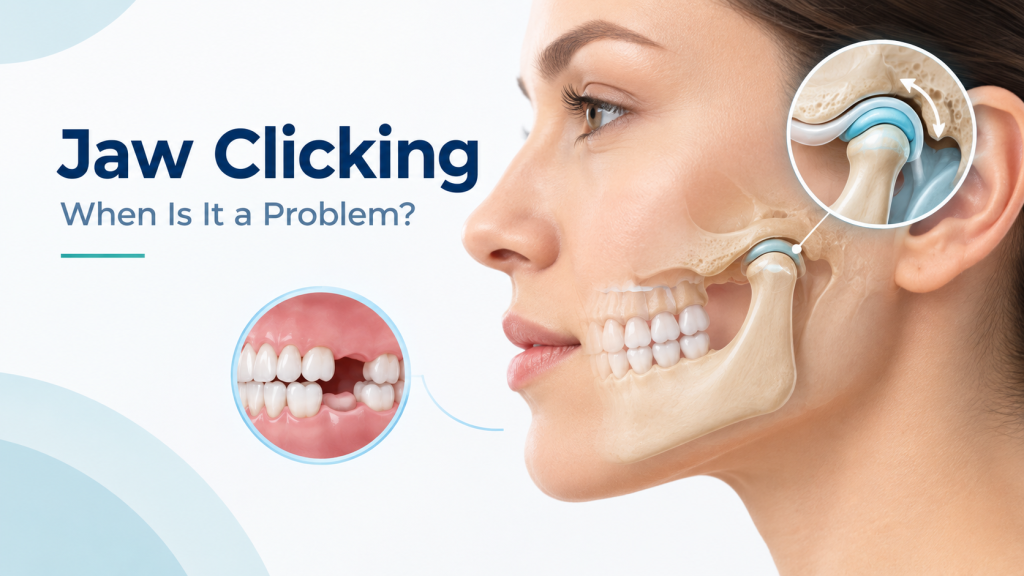
A clicking jaw tells two very different stories, and most patients only ever hear about one of them. The common story is a small cartilage disc inside the joint slipping slightly out of place, usually harmless, often lifelong, rarely worth treating on its own. The story almost nobody mentions is that clicking can also show up gradually, years after losing back teeth that were never replaced, as the bite quietly shifts and the jaw joint absorbs forces it was never designed to handle alone.
Quick Answer
Jaw clicking most often happens when the small cartilage disc inside the temporomandibular joint slips slightly out of position and then back again as the jaw opens and closes. Painless clicking with full, normal jaw movement usually needs no treatment at all. Clicking that comes with pain, locking, or a jaw that’s gradually becoming harder to open fully is worth a professional evaluation, and in some patients, the underlying driver turns out to be missing back teeth that have let the bite shift out of its original alignment.
At a Glance
| Clicking Alone | Clicking Plus a Red Flag | |
|---|---|---|
| Pain | None | Present, in the joint, jaw, or radiating to the ear or temple |
| Jaw movement | Full, normal range | Limited opening, or jaw locking open or shut |
| Typical cause | Disc slightly out of position | Same, plus possible bite changes, grinding, or joint damage |
| Needs treatment? | Usually not | Usually yes, evaluation at minimum |
What’s Actually Clicking
The temporomandibular joint connects your jawbone to your skull just in front of each ear, and it’s one of the only joints in the body that relies on a small, movable cartilage disc to let the jaw open smoothly. According to the National Institute of Dental and Craniofacial Research, when that disc sits slightly forward of where it should, it can slip back into proper position with an audible click as you open your mouth, and slip forward again with another click as you close it. That’s the clicking sound itself: cartilage catching and releasing, not bone grinding on bone.
Why Painless Clicking Usually Isn’t a Problem
A disc that clicks but still lets the jaw open fully, without pain, without catching, is functioning well enough that most dentists won’t recommend treating it at all. Plenty of people live with a clicking jaw for decades with no progression and no discomfort. Treating a symptom that isn’t actually bothering anyone, isn’t limiting function, and isn’t a sign of a worsening joint, tends to create more intervention than the situation calls for.
The Signs That Change the Picture
A few specific changes are worth paying attention to, and they’re genuinely different from ordinary clicking. Pain in the joint itself, or pain radiating to the ear, temple, or jaw muscles, is the clearest signal. A jaw that’s becoming harder to open all the way, or one that’s visibly deviating to one side as it opens, suggests the joint mechanics are changing, not just producing noise. Locking, where the jaw genuinely gets stuck open or shut even briefly, is a step beyond simple clicking and warrants prompt evaluation. And clicking that’s new and getting louder or more frequent over a period of weeks, rather than a sound you’ve had unchanged for years, deserves a closer look rather than an assumption that it’s the same harmless click you’ve always had.
The Cause Most Articles Skip: What Missing Back Teeth Do to Your Bite
Here’s the piece of this picture that rarely makes it into general jaw-clicking content. When a back tooth is lost and never replaced, the teeth around it don’t stay put. Neighboring teeth drift, the opposing tooth can supererupt into the gap, and over time the bite loses some of its vertical support in that area, a recognized clinical pattern called posterior bite collapse. A 2022 review in the International Journal of Periodontics & Restorative Dentistry describes this exact syndrome, noting that lost posterior support can progressively affect the entire bite and lists temporomandibular disorder as one of its documented secondary consequences, alongside increasing tooth mobility and further tooth loss. Separate clinical case reports describe the same mechanism directly: prolonged tooth loss without replacement can disrupt chewing function and contribute to jaw joint disorders as the bite’s vertical dimension collapses and the mandible shifts to compensate.
The reason this connection gets missed so often is simple: patients experiencing jaw clicking think of it as a jaw problem and look for jaw-specific causes, stress, grinding, an old injury, without necessarily connecting it to a back tooth they lost years earlier and never got around to replacing. The jaw joint, meanwhile, has been quietly absorbing the consequences of that gap the entire time.
Putting This Together: What to Actually Do
If your clicking is painless, stable, and your jaw opens fully and normally, there’s generally nothing urgent to act on, though mentioning it at your next dental checkup is a reasonable, low-effort step. If you’re noticing pain, locking, or a jaw that’s becoming harder to open, see a dentist for an evaluation rather than waiting it out, since catching a developing issue earlier generally means simpler treatment. And specifically, if you’re missing one or more back teeth that were never replaced, mention that directly when discussing jaw symptoms, even if it doesn’t seem like an obvious connection. It’s worth having your dentist check your bite alignment and vertical dimension as part of working out what’s actually driving the clicking, rather than treating the jaw symptom in isolation from a dental cause sitting a few teeth away.
When Replacing a Missing Tooth Is Part of the Actual Fix
If posterior bite collapse turns out to be a meaningful contributor to your jaw symptoms, the treatment conversation shifts from jaw-specific therapy toward restoring what the bite actually lost: the missing tooth or teeth themselves. Depending on your case, that might mean a bridge, a partial denture, or a dental implant, each of which our dental implants cost guide and root canal plus crown versus implant cost guide cover from a cost standpoint, alongside the clinical decision-making your dentist will walk you through.
Frequently Asked Questions
Does every clicking jaw need a night guard?
No. A night guard addresses grinding and clenching specifically. If your clicking isn’t accompanied by pain, wear patterns, or a grinding habit, a night guard may not be the relevant treatment for your particular cause.
Can jaw clicking go away permanently?
Sometimes, particularly if it’s tied to a temporary cause like recent stress or an isolated injury. Clicking tied to a structural factor, such as a disc position that’s been the same for years or an unreplaced missing tooth, tends to persist until that underlying factor is addressed, if it’s addressed at all.
Is jaw clicking a sign I need surgery?
Almost never on its own. The overwhelming majority of jaw joint symptoms resolve with conservative, non-surgical approaches. Surgery is reserved for a small minority of cases involving structural joint damage that hasn’t responded to other treatment.
How would I know if a missing tooth is actually connected to my jaw clicking?
This isn’t something to self-diagnose. A dentist can assess your bite, check for vertical dimension loss, and look at whether your missing tooth or teeth sit in a position that would plausibly affect your bite mechanics on the clicking side.
Should I be worried if only one side of my jaw clicks?
One-sided clicking is common and doesn’t automatically indicate a bigger problem. It’s worth mentioning to a dentist alongside any other symptoms, but clicking limited to one side isn’t inherently more concerning than clicking on both.
Can clicking start suddenly in adulthood with no clear trigger?
Yes, and it’s not unusual. Gradual changes like tooth wear, slow bite shifts from an old missing tooth, or an unnoticed increase in clenching can all produce clicking that seems to appear out of nowhere, when it actually developed slowly over time.
The Bottom Line
Most jaw clicking is a disc quietly slipping in and out of position, and on its own, without pain or restricted movement, it’s rarely something to treat. Pain, locking, or a jaw that’s becoming harder to open changes that picture and deserves a real evaluation. And if you’re carrying an unreplaced missing back tooth alongside your jaw symptoms, that’s worth mentioning specifically, since posterior bite collapse is a documented, if often overlooked, contributor to exactly this kind of joint symptom.
Sources: National Institute of Dental and Craniofacial Research, TMJ Disorders · Posterior Bite Collapse: Guidelines for Treatment Based on Form and Function, International Journal of Periodontics & Restorative Dentistry, 2022 · Posterior bite collapse and TMJ disorder, case report, PMC