
Gum Boil: Causes, What It Looks Like, and Why It Keeps Coming Back
A patient once told me their gum boil had “healed itself” three separate times over a year, each time after it burst on its own and the ache disappeared. It never healed. Every single time, it was draining, not resolving, and the infection feeding it sat there quietly the entire time, waiting to flare again. That’s the detail about a gum boil most people get wrong: whether it hurts has almost nothing to do with whether it’s dangerous.
Quick Answer
A gum boil, clinically a parulis, is a small bump where a dental infection has tunneled through to the surface to drain. It’s almost always caused by a dead or infected tooth, advanced gum disease, or a reinfected root canal. It needs treatment even when painless, since drainage relieving pressure isn’t the same as the infection resolving.
Seek Care Immediately If You Notice These Signs
Before anything else, these symptoms mean a dental infection may be spreading beyond the tooth, and Mayo Clinic is direct about this: go to an emergency room, not a regular dental appointment, if you have:
- Difficulty breathing or swallowing
- Facial, cheek, or jaw swelling that’s visibly growing
- A fever alongside swelling, especially if you can’t reach a dentist quickly
- Swelling spreading toward the eye or down into the neck
A weakened immune system raises the stakes further, since Mayo Clinic notes it increases the risk of a dental infection spreading beyond the mouth. None of this is meant to alarm you over a small, stable bump, most gum boils aren’t this urgent, but these specific signs are not ones to sleep on.
What a Gum Boil Actually Is
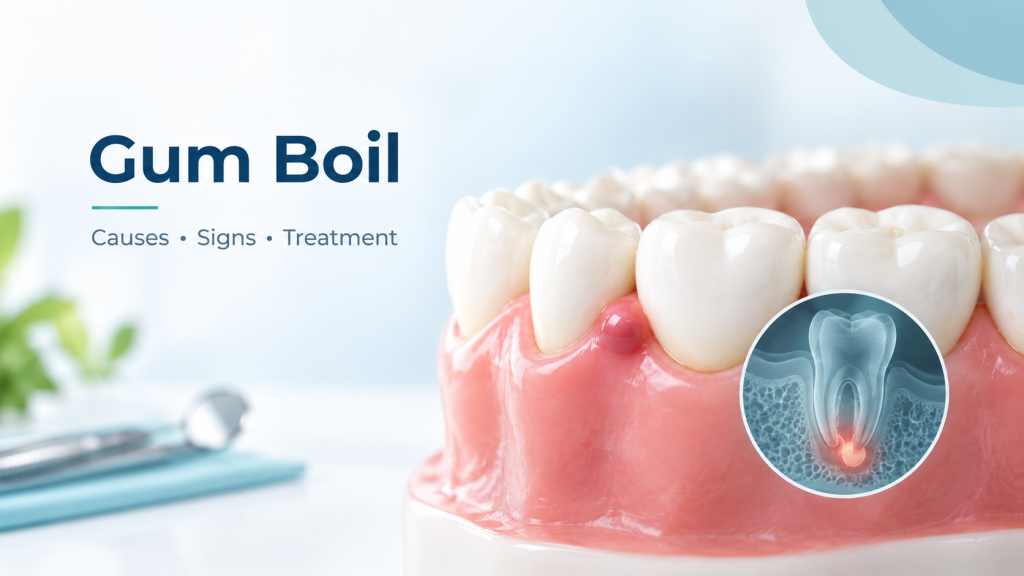
A gum boil forms when an infection inside or around a tooth needs somewhere to go. Pressure from the trapped infection pushes a narrow channel, dentists call it a sinus tract, through the bone and gum tissue until it reaches the surface, and the visible bump is simply where that tunnel opens. It’s worth knowing that in the clinic, we sometimes thread a thin gutta-percha point gently into that opening and take an X-ray, since the material traces the tunnel back to its actual source, which isn’t always the tooth closest to the bump. The boil tells you an infection exists. It doesn’t tell you, just by looking, exactly which tooth is responsible.
What’s Actually Causing Yours
Three sources account for the large majority of cases I see:
A dead or dying tooth. Once the nerve inside a tooth dies, usually from deep decay or an old injury, bacteria take over the empty space and the infection works its way out through the root tip. This is the most common source, and it typically needs root canal treatment or extraction.
A gum pocket gone wrong. Advanced gum disease creates deep pockets between the tooth and gum where bacteria accumulate. When one of these pockets gets sealed off, the trapped infection becomes a periodontal abscess, draining through the gum as a boil, usually alongside bleeding, recession, or looseness in the surrounding teeth.
A root canal that didn’t fully resolve. A previously treated tooth can become reinfected if bacteria were missed during the original procedure or a new crack lets bacteria back in. The boil shows up near the same tooth, and retreatment is often on the table.
What It Actually Looks and Feels Like
Picture a small, round or dome-shaped bump, usually somewhere between the size of a pea and a grape, sitting near the base of a tooth or along the gumline. Color shifts depending on what stage it’s in: reddish-pink when it’s actively filling, whitish or yellow at the tip once a pus pocket forms, and flat, pale pink once it’s drained, which is exactly the look that fools people into thinking it’s gone. It usually feels soft, sometimes almost like a small fluid-filled blister. A salty or unpleasant taste often shows up if it’s actively draining into the mouth.
The Pain Paradox Worth Understanding
Here’s the part I’d really want every patient to internalize: a gum boil frequently causes little to no pain, and it’s most comfortable exactly when it’s draining, because drainage is what relieves the pressure that was causing the ache in the first place. That relief has nothing to do with the infection being gone. It means the pressure valve is working. The bacteria causing the problem are still there, the bone around the tooth can still be affected, and the boil can refill and swell again without warning. A painless gum boil is not a healed gum boil, and treating it as one is the single most common reason these keep coming back for months or longer.
Gum Boil, Cyst, or Something Else Entirely
Several different things can look like “a bump on my gum,” and they’re not treated the same way.
| Gum boil (abscess) | Dental cyst | Mucocele | Canker sore | |
|---|---|---|---|---|
| What it is | Active infection draining to the surface | Slow-growing fluid sac around a root | Blocked salivary gland, mucus-filled | Open ulcer, not a bump |
| Pain level | Variable, often minimal once draining | Usually painless | Usually painless | Painful |
| How it’s found | Visible bump | Usually only on X-ray | Visible, soft, bluish-clear bump | Visible sore |
| Typical location | Near a tooth root or gumline | Around a tooth root, seen on imaging | Inner lip or floor of mouth more than gums | Inside cheeks, lips, tongue |
| Urgency | Needs prompt dental evaluation | Managed based on size and growth | Often resolves on its own, can be removed if recurrent | Usually heals in 1 to 2 weeks |
A mucocele is worth knowing about specifically because it’s so often mistaken for a gum boil. It comes from a blocked or injured salivary gland rather than infection, tends to look more bluish or translucent, and isn’t a sign of dental decay or gum disease at all.
How This Actually Gets Treated
Treatment works in two parts, and skipping the second one is exactly why a boil keeps resurfacing. First, the abscess gets drained to relieve the acute pressure, with antibiotics added if there’s any sign the infection is spreading beyond the local area. Second, and this is the part that actually ends it, the source gets addressed directly: root canal therapy if the tooth can be saved, deep cleaning if it’s a periodontal pocket driving things, or extraction if the tooth is too far gone to save. Draining the boil without treating what’s feeding it is roughly like bailing water out of a boat without patching the hole.
What Not to Do While You Wait for an Appointment
Warm salt water rinses several times a day can ease discomfort and support gentle drainage, and that’s a reasonable thing to do at home. What you shouldn’t do is squeeze or pop the bump yourself, which risks pushing bacteria deeper into the tissue rather than out of it, and you shouldn’t assume a round of leftover antibiotics from a past prescription is a fix, since antibiotics control an infection, they don’t repair or remove its source.
When the Tooth Can’t Be Saved
Sometimes the source tooth has simply been compromised too long, through repeated infection, bone loss, or structural damage, to make saving it realistic. If extraction becomes the recommendation, that opens a separate decision about what replaces the tooth. Our guide to root canal plus crown versus implant cost walks through how that choice gets made when a tooth is on the edge, and our dental implants cost guide covers what replacement actually involves once extraction is the path forward.
Preventing the Next One
Since gum boils trace back to decay, gum disease, or compromised past dental work, the prevention list is short and familiar: address tooth pain and visible decay before it reaches the nerve, keep up with professional cleanings if you’ve ever had deep gum pockets, and don’t skip follow-up on old root canals or crowns, since reinfection there can sit quiet for years before it surfaces.
Frequently Asked Questions
Can a gum boil actually heal on its own?
It can shrink or burst and look like it’s gone, especially right after draining, but it almost always returns because the underlying infection, a dead tooth, deep decay, or gum disease, is still there. Lasting resolution requires treating that source directly.
Is it ever okay to just wait and watch a gum boil?
A small, stable boil with no other symptoms should still be seen promptly, just not necessarily as an emergency. Any of the red-flag symptoms above change that immediately.
What’s actually inside a gum boil?
Pus, the byproduct of your immune system fighting a bacterial infection, along with the bacteria themselves. It’s the same material you’d find in an abscess anywhere else in the body.
Will antibiotics alone get rid of it?
They can control the infection temporarily, especially if it’s spreading, but they don’t remove the source. Without root canal therapy, deep cleaning, or extraction depending on the cause, the boil tends to return once the antibiotic course ends.
Why does mine keep coming back in the exact same spot?
Because the sinus tract is draining the same ongoing infection every time. It’s not a new problem recurring, it’s one unresolved problem resurfacing, which stops once the actual source is treated.
Could this be something other than an infection?
Possibly, a mucocele or a dental cyst can both resemble a gum boil on the surface. A dental exam, sometimes with imaging, is the reliable way to tell them apart rather than guessing from appearance alone.
The Bottom Line
A gum boil is your body’s way of relieving pressure from an infection it hasn’t been able to clear on its own, and whether it hurts tells you very little about how serious it is. Watch specifically for spreading swelling, fever, or trouble breathing or swallowing, since those call for emergency care, not a routine appointment. Otherwise, get it evaluated so the actual source gets treated, not just the bump itself, which is the only thing that actually stops it from coming back.
Sources: Mayo Clinic, Tooth Abscess: Symptoms and Causes · ADA MouthHealthy, Abscess · National Institute of Dental and Craniofacial Research, Gum Disease