
Veneers vs Crowns: What’s the Real Difference?
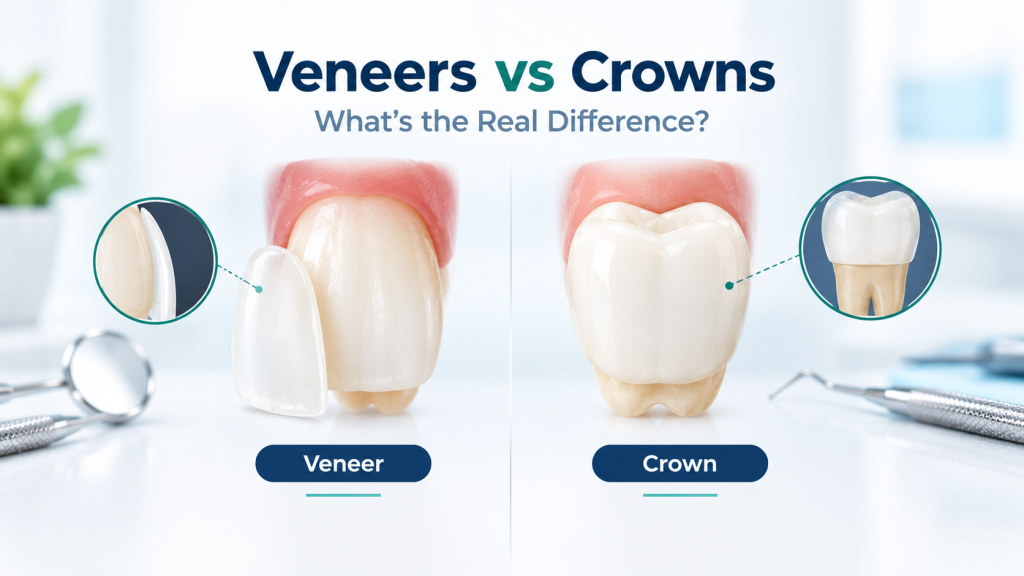
Here’s the fact that gets buried under all the talk of cost and appearance: neither a veneer nor a crown can be undone. Once a dentist shaves enamel off your tooth to make room for either one, that enamel is gone permanently, whether the restoration lasts two years or twenty. That single detail should shape this decision far more than most people realize going in, because the two options aren’t really competing for the same job. One protects a tooth that’s already been damaged. The other changes how a healthy tooth looks. Getting that distinction backwards is how patients end up either over-treating a healthy tooth or under-protecting a weak one.
Quick Answer
A crown wraps around the entire tooth and is built to restore strength to a tooth that’s cracked, heavily decayed, or weakened by a root canal. A veneer covers only the front surface and is built to improve the appearance of a tooth that’s already structurally healthy. Crowns require removing roughly 1.5 to 2 millimeters of tooth on every surface; veneers remove a thin sliver, often under a millimeter, from the front face only. Both changes are permanent, regardless of which one you choose.
At a Glance
| Crown | Veneer | |
|---|---|---|
| Coverage | Entire tooth | Front surface only |
| Purpose | Restore strength and function | Improve appearance |
| Tooth structure removed | More | Less |
| Best suited for | Cracked, heavily decayed, root-canal-treated teeth | Discolored, chipped, slightly misaligned but healthy teeth |
| Reversible | No | No |
| Insurance | Often partially covered | Rarely covered |
The One Thing Both Have in Common: Neither Comes Off
This is worth sitting with before anything else. A crown requires your dentist to reduce the entire visible tooth, every surface, to make room for the cap that goes over it. A veneer requires shaving a thin layer of enamel off the front face. In both cases, that removed structure doesn’t grow back, and once it’s gone, you’re committed to wearing some kind of restoration on that tooth indefinitely. If the veneer or crown ever needs replacing down the line, it gets replaced with another one, not reverted to a bare natural tooth. Knowing this upfront changes how seriously the decision deserves to be weighed, especially for a veneer being considered on a tooth that was otherwise perfectly healthy.
Why a Crown Exists: Rebuilding What’s Already Compromised
A crown’s entire purpose is structural. It wraps fully around a tooth that’s lost enough of its own strength that a thinner fix won’t hold up under daily chewing. This is the standard recommendation after a root canal, since removing the nerve and blood supply leaves a tooth noticeably more brittle and prone to cracking without full-coverage protection. It’s also the right call for a tooth with a crack extending down toward the root, where a crown functions almost like a splint, holding the structure together under the forces of normal biting. And when decay or an old, failing filling has eaten away more than roughly half the visible tooth, a crown rebuilds what’s missing rather than asking a filling to bridge a gap it was never designed to span.
Why a Veneer Exists: Changing Appearance Without Rebuilding Structure
A veneer’s job is almost the opposite. It exists for teeth that are already structurally sound but look wrong for reasons whitening can’t fix: intrinsic staining from tetracycline or fluorosis, old trauma that darkened the tooth from the inside, a chipped edge, a gap between the front teeth, or a tooth that’s mildly rotated or uneven in length. In every one of these cases, the tooth underneath doesn’t need rebuilding. It needs a new front surface, which is exactly what a thin porcelain shell provides while leaving the back, sides, and most of the tooth’s internal structure untouched.
The Bruxism Factor Most Patients Underweight
Here’s a genuinely important variable in this decision that doesn’t get enough attention: how hard you clench or grind your teeth changes the entire risk profile of a veneer. A systematic review of porcelain veneer studies found a 10-year cumulative survival rate of 95.5 percent, a strong number overall. But a separate clinical study tracking 323 veneers found that the large majority of fractures and debonding incidents occurred specifically in patients with bruxism, and other reporting on this same risk factor has noted veneer success rates dropping as low as 60 percent in patients with active, unmanaged grinding. If you grind or clench, that’s not a reason to rule out veneers entirely, but it is a reason to discuss a protective night guard as part of the plan, or to seriously weigh whether a crown’s added strength is worth more to you than a veneer’s more conservative approach to tooth structure.
When the Decision Sits in a Gray Zone
Some teeth genuinely could go either way, and this is where a dentist’s judgment matters most. A front tooth under a moderate cosmetic concern with a small existing filling might reasonably be treated with either option. The deciding factors tend to be how much healthy structure actually remains (more structure favors the more conservative veneer), where the tooth sits in your bite (front teeth handle far less chewing force than molars, which is part of why veneers are rarely placed on back teeth at all), whether grinding is a factor, and whether you’re already planning a broader cosmetic change involving several front teeth, where veneers often give a more controlled, uniform result across the whole smile.
Cost and Insurance, Briefly
Crowns are generally classified as restorative treatment, so many dental PPO plans cover a meaningful portion once your deductible is met. Veneers are almost always classified as cosmetic and excluded from coverage entirely, with rare exceptions when a veneer is being placed specifically to repair a chip or fracture rather than purely for appearance. This difference alone shifts the real-world cost comparison more than the sticker prices do on their own.
When Neither One Is Actually the Right Answer
Sometimes a tooth has been compromised long enough, through repeated decay, a deep fracture, or advanced gum disease, that neither a crown nor a veneer gives it a realistic long-term future. That’s a different conversation entirely, one about whether the tooth is worth saving at all. Our guide to root canal plus crown versus implant cost walks through exactly how that decision gets made, and our dental implants cost guide covers what replacement involves if extraction turns out to be the more realistic path.
Frequently Asked Questions
Can I get a veneer instead of a crown if I just want to spend less?
Not safely, if the tooth is actually damaged. A veneer doesn’t provide the structural reinforcement a compromised tooth needs, and placing one on a tooth that really needs a crown risks the veneer failing or the underlying damage worsening underneath it.
Is it true that neither a crown nor a veneer can ever be reversed?
Yes. Both require removing a portion of your natural tooth to make room for the restoration, and that structure doesn’t return even if you later decide not to replace the restoration.
Does grinding my teeth rule out veneers completely?
No, but it does raise the real risk of fracture or debonding, and it’s a factor worth discussing honestly with your dentist, often alongside wearing a night guard to protect the investment either way.
Can a veneer be placed on a back tooth?
Rarely. Back teeth handle far more chewing force than front teeth, which is part of why crowns are the standard choice for molars and premolars that need restoration, not veneers.
If I get a root canal, do I always need a crown afterward?
Not always, particularly on front teeth, which handle less force and can sometimes be restored with a filling instead. Back teeth after a root canal typically do need a crown, since they handle much greater chewing force and have lost structural integrity in the process.
How do I know if my tooth is a candidate for either option, or neither?
Only an exam with X-rays can determine this reliably, since it depends on exactly how much healthy structure remains, whether the root is sound, and the condition of the surrounding gum and bone.
The Bottom Line
A crown and a veneer aren’t two versions of the same choice, they solve two different problems: one restores a tooth that’s already compromised, the other reshapes the appearance of one that’s already healthy. Both are permanent changes to your natural tooth, which is reason enough to make sure you’re solving the right problem before treatment begins. If you grind your teeth, say so clearly during your consultation, since it genuinely changes the calculation. And if a tooth turns out to be too far gone for either option, that’s a conversation worth having honestly rather than forcing a restoration onto a tooth that won’t hold it.
Sources: Long-Term Survival and Complication Rates of Porcelain Laminate Veneers, Systematic Review, PMC · Influence of Bruxism on Survival of Porcelain Laminate Veneers, PMC