
What Does a Cavity Look Like? A Stage-by-Stage Guide
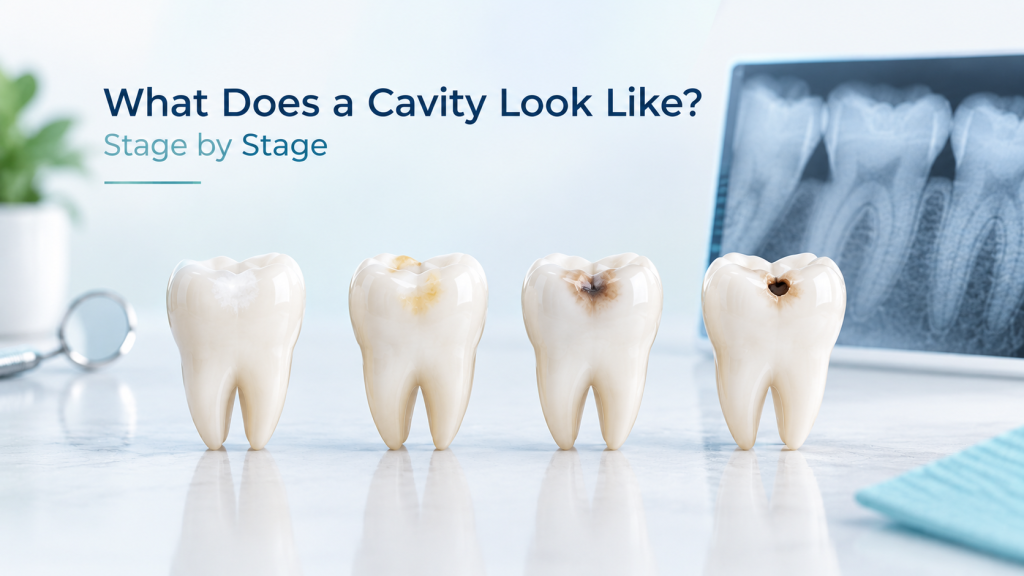
Ask most people to picture a cavity and they’ll describe a black hole, something obvious you’d spot in the mirror without trying. In my own practice, I catch the majority of cavities before a patient has any idea they’re there, often as nothing more than a faint chalky patch or a shadow on an X-ray that wouldn’t mean anything to an untrained eye. By the time decay actually looks like what people imagine, it’s usually already done real damage.
Quick Answer
A cavity starts as a chalky white spot, darkens to yellow, brown, or black as decay deepens, then forms a visible hole or pit. Many cavities, especially between teeth, show nothing on the surface and are found only on a dental X-ray, where decay appears as a dark shadow against healthy, denser tooth structure.
The 4 Stages of a Cavity, at a Glance
| Stage | What you’d actually see | Reversible? |
|---|---|---|
| 1. Early demineralization | A dull white, chalky patch | Often, with fluoride and better hygiene |
| 2. Enamel decay | The white spot shifts to yellow or light brown | No, needs a filling |
| 3. Dentin decay | Darker brown to black, often with sensitivity | No, needs a filling |
| 4. Advanced decay | Visible hole, dark pit, or a piece that’s broken off | May need a crown or root canal |
A national CDC survey found that 27 percent of American adults aged 20 to 64 are living with untreated tooth decay right now, more than one in four. Most of those cases started exactly at stage one, as a spot most people never noticed.
Stage 1: The Spot That Doesn’t Look Like Decay At All
Long before a cavity forms, enamel starts losing minerals to acid produced by bacteria feeding on sugar and starch left behind on the teeth. The first visible sign is a dull, opaque white patch, nothing dramatic, often mistaken for dried toothpaste or simply overlooked entirely. This is the one stage where the clock can genuinely be turned back. According to ADA MouthHealthy, the ADA’s own consumer oral health resource, fluoride and consistent brushing and flossing can remineralize enamel at this stage before a physical hole ever forms.
Stage 2: When the Color Starts to Shift
Left alone, that white patch doesn’t stay white. As the acid attack continues and the enamel surface starts to physically break down, the spot darkens, first to yellow, then to a light brown. In my experience, the tooth usually still doesn’t hurt at this point, which is exactly why this stage gets missed so often. Nothing about a dull brown spot screams “emergency,” even though the decay has already moved past the point where hygiene alone can fix it.
Stage 3: Decay Reaches the Dentin
Once decay works through the enamel and into the dentin, the softer layer underneath, things tend to move faster, since dentin offers far less resistance than enamel. The spot typically darkens further toward brown or black, and this is usually the first point where patients actually notice something, often sensitivity to cold, sweets, or pressure, sometimes a rough edge they can feel with their tongue. A hole or pit frequently becomes visible here, though its size on the surface doesn’t always match how deep the decay runs underneath.
Stage 4: Decay Gets Serious
If dentin decay goes untreated, it continues toward the pulp at the center of the tooth, where the nerve and blood supply sit. At this stage you’re often looking at visible structural damage, a gray tint to the tooth, a chunk that’s chipped or broken away, genuine pain, or lingering sensitivity to temperature. This is the stage where a simple filling usually isn’t enough, and treatment shifts toward a root canal, a crown, or in some cases extraction.
What a Cavity Actually Looks Like on an X-Ray
Here’s the detail that surprises a lot of patients: most cavities never show up as anything you could spot by looking, because they’re hiding between teeth, under an old filling, or inside the deep grooves of a molar. On a bitewing X-ray, healthy enamel and dentin read as light gray to white, since they’re dense. Decayed tooth structure is less dense, so it shows up as a darker shadow within the tooth. A classic between-teeth cavity typically appears as a small, triangular dark area starting right at the point where two teeth touch, pointing inward toward the center of the tooth. Decay forming underneath an existing filling or crown shows up as a dark patch tucked beneath the denser, brighter restoration material. This is the entire reason routine X-rays matter, confirmed by the National Institute of Dental and Craniofacial Research: a cavity invisible to the eye and too small to hurt yet is often perfectly obvious on film.
The Cavities Hiding Where You Can’t See Them
Between-teeth decay is the one that catches people off guard most often, precisely because the tooth can look completely normal from the front. A few subtle clues sometimes hint that something’s developing in that hidden space: food that keeps getting stuck in the same spot, floss that shreds or catches differently on one particular tooth, or sensitivity you can feel but can’t actually pinpoint to a specific surface. None of these guarantee a cavity is there, but in my own patients, they’re worth mentioning at the next cleaning rather than waiting to see if it gets worse.
Is That Spot Actually a Cavity, or Just a Stain?
Not every dark mark on a tooth is decay. Surface staining from coffee, tea, or tobacco sits on top of the enamel and can usually be polished off, while a cavity is a genuine structural softening or break in the tooth itself. On the lighter end, a white spot can be an early cavity, or it can be fluorosis or a developmental enamel defect that has nothing to do with decay. Telling the two apart reliably takes a clinical exam, where a dentist checks whether the area feels soft, catches on an instrument, or shows up as decay on an X-ray, not a guess based on color alone.
Why This Matters Beyond the Spot Itself
Most cavities caught early end with a straightforward filling. The patients I see with a far bigger decision ahead of them are usually the ones where decay sat untreated long enough to destroy too much of the tooth to support a filling or even a crown, at which point extraction and whatever replaces that tooth becomes the real conversation. If you’re ever facing that choice yourself, our guide to root canal plus crown versus implant cost walks through what that decision actually involves, our dental implants cost guide covers what replacing a tooth looks like if saving it isn’t realistic, and if cost is the thing holding you back from addressing it, our guide to affordable implants through dental schools and community clinics covers lower-cost paths worth knowing about. Catching a cavity back at stage one is how you avoid ever needing any of these.
What to Actually Do If You Spot Something
See a dentist for an exam rather than trying to diagnose a spot yourself from a photo or a description online. If it turns out to be stage-one demineralization, your dentist can guide you through a fluoride and hygiene plan rather than jumping straight to a filling. If it’s progressed further, catching it now instead of in six months is, in my experience, very often the difference between a small filling and a much larger procedure later.
Frequently Asked Questions
Can a cavity disappear on its own?
Only at stage one, the white-spot phase, where remineralization with fluoride and consistent hygiene is genuinely possible. Once decay has physically broken through the enamel, it won’t reverse and needs professional treatment.
Is a white spot always a cavity?
No. It’s often stage one of a cavity, but it can also be fluorosis or an enamel developmental defect unrelated to decay. A dentist can tell the difference on exam.
Why don’t I feel pain until a cavity is already serious?
Enamel has no nerve supply, so decay moving through it typically causes no sensation. Pain usually starts once decay reaches the dentin or gets close to the nerve inside the tooth, by which point it’s already past stage one or two.
How often should I get dental X-rays to catch cavities early?
This depends on your personal risk factors and history, which your dentist will factor in, but routine bitewing X-rays are standard practice precisely because so many cavities are invisible without them.
Can a cavity get bigger quickly?
It can, particularly once it reaches dentin, which breaks down faster than enamel. A small, early cavity can progress meaningfully within months if left untreated.
What happens if a cavity is left untreated for years?
It can progress to infection, significant structural loss, and eventually a tooth that can’t be saved with a filling or crown, at which point extraction and tooth replacement become the realistic options.
The Bottom Line
A cavity almost never starts out looking like the hole most people picture. It begins as a faint white patch at stage one, darkens in stages as it works deeper into the tooth, and very often develops somewhere you can’t see at all, between teeth or under existing dental work, found only on an X-ray. Catching it at stage one is the one point where you genuinely have options beyond a drill. If a cavity has already progressed past that point in your own mouth, see a dentist for an actual diagnosis rather than trying to match what you’re seeing to a description online.
Sources: CDC/National Center for Health Statistics, Dental Caries and Tooth Loss in Adults in the United States · ADA MouthHealthy, Cavities / Tooth Decay · National Institute of Dental and Craniofacial Research, Tooth Decay