Same-Day Dental Implants Cost: What “Teeth in a Day” Actually Gets You
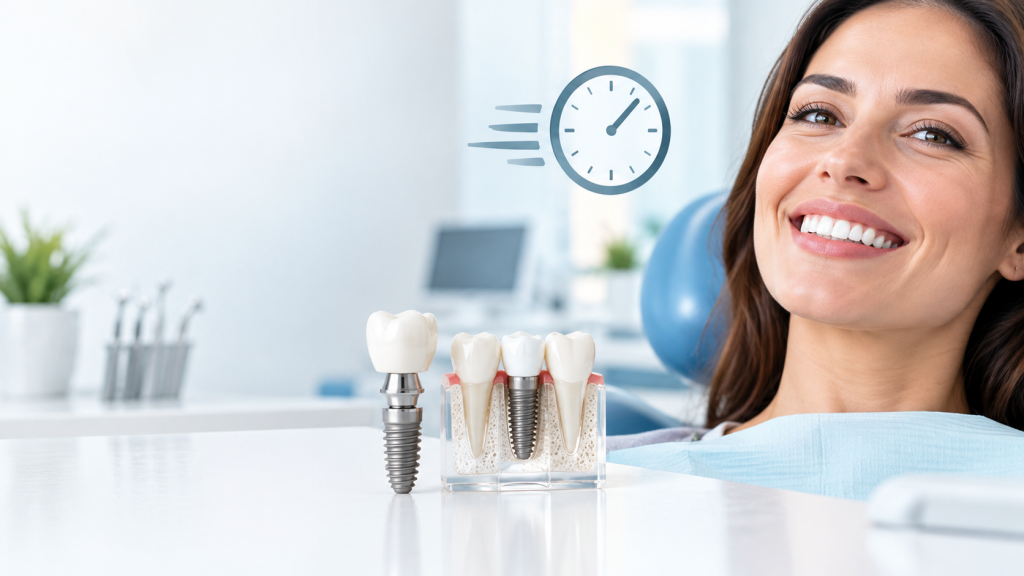
“Teeth in a day” is a catchy phrase, and it’s technically accurate, but it tends to create a misleading picture in patients’ heads. Walking out of surgery that afternoon with a functioning tooth is real. Walking out with your final, permanent tooth is not. What you’re leaving with is a temporary crown or bridge attached to an implant that still needs several months underneath the gum to fuse properly with your jawbone, a process no amount of same-day convenience can speed up.
Quick Answer
Same-day, or immediate load, dental implants cost a national average of $3,255, with a typical range of $2,506 to $5,953. That figure covers the implant and the temporary tooth placed the same day as surgery. A permanent crown or bridge replaces the temporary one after the implant has fused with the bone, usually three to six months later. Patients choosing this option can expect outcomes close to those of a traditionally placed implant, with published success figures sitting in the mid-to-high nineties.
At a Glance
| Detail | |
|---|---|
| National average cost | $3,255 |
| Typical range | $2,506 to $5,953 |
| What’s included same-day | Implant placement, abutment, temporary crown or bridge |
| Healing before permanent restoration | Typically 3 to 6 months |
| Success rate | 94% to 98% |
| Best candidates | Good bone density, healthy gums, no major infection at the site |
What “Same-Day” Actually Means, Clinically
With a traditional implant, the surgeon places the post, then sends you home with a gap, or a temporary removable appliance, while the bone fuses around it for several months before attaching anything permanent. With an immediate load implant, that temporary tooth goes on the same day the post goes in, right after your surgeon confirms the implant has enough initial stability in the bone to support it. You leave with something you can see and chew with, carefully, from day one.
The real fusing of bone to implant underneath the gum still takes however long your own healing takes, whether you choose the immediate route or the traditional one. What changes with a same-day approach is the wait you actually notice day to day, the gap in your smile and your ability to chew, not the underlying biological timeline itself.
What Drives the Cost
CareCredit’s national cost study lists several factors that move the price within that $2,506 to $5,953 range: how many implants your case needs, whether you’re getting a single crown or a full bridge, your surgeon’s experience level, your geographic location, whether extractions or bone grafting are needed beforehand, and the material chosen for the prosthetic teeth. A single tooth sits toward the lower end of that range, while a same-day bridge replacing several teeth pushes toward the higher end.
Here’s a detail worth sitting with before comparing this number to a standard implant quote: this $3,255 average covers the full same-day restoration, the implant, abutment, and temporary tooth together. A separately published figure for a standard single-tooth implant post (without the crown) averages $2,143. These aren’t the same measurement, so a direct side-by-side comparison between the two numbers alone would be misleading. The honest comparison is scope-for-scope: a complete standard implant case, post through final crown, typically still lands in a similar $3,000 to $6,000 range once everything is included, a figure we cover in full in our dental implants cost guide.
Same-Day Cost by State
| State | Average cost | State | Average cost |
|---|---|---|---|
| Alabama | $2,910 | Montana | $3,241 |
| Alaska | $3,944 | Nebraska | $2,921 |
| California | $3,958 | New York | $3,558 |
| Hawaii | $4,947 | Ohio | $2,945 |
| Massachusetts | $3,652 | Oklahoma | $2,764 |
| Oklahoma | $2,764 | Texas | $2,966 |
Full source table: CareCredit, Immediate-Load Dental Implants Cost and Procedure Guide, 2024 Synchrony Average Procedural Cost Study, ASQ360° Market Research. For the complete 50-state breakdown on standard implant pricing, see our dental implant cost by state guide.
Are You Actually a Candidate?
Same-day implants work well for patients with solid bone density, healthy gums, and no active infection at the implant site, since the implant needs enough initial stability right out of the gate to support a temporary tooth immediately. Patients who smoke heavily, grind their teeth, or have significant bone loss are often steered toward the traditional timeline instead, where the implant heals undisturbed before anything is attached to it. A 3D imaging scan and a full health review during your consultation are what actually determine this, not your own preference for speed.
What Treatment Actually Looks Like
Before surgery, your dentist evaluates your oral health with imaging and plans the implant placement virtually. Any damaged teeth get extracted first if needed, and in some cases a bone graft is done ahead of time to strengthen the site. On surgery day, your surgeon administers local anesthesia, places the implant into the jawbone, attaches the abutment, and fits a temporary crown or bridge, restoring your appearance and basic function right away. That temporary piece stays in place for three to six months while osseointegration happens underneath. Once your follow-up visit confirms the implant has fused properly and your bite is aligned correctly, the temporary is swapped out for your permanent crown or bridge.
Risks Worth Knowing About
Outcomes for this approach hold up well against the traditional route, with published figures putting success somewhere between 94 and 98 percent, a range that lines up closely with implants placed the conventional way. Short-term side effects like swelling, bruising, soreness, or minor bleeding at the surgical site are common and typically resolve within days. The more serious risks, infection or implant failure, are more likely if aftercare instructions aren’t followed closely, or if the patient smokes or grinds their teeth, both of which can interfere with the bone properly fusing to the implant while it’s already under light function from the temporary tooth.
Recovery
Gentle brushing twice a day and an antibacterial rinse as directed by your dentist are standard early on. Soft foods are recommended for the first few days, and hard or sticky foods are off-limits until your dentist clears you, since unnecessary pressure on a newly placed implant can interfere with healing. Most patients return to normal work and exercise within a few days, though the implant itself is still quietly fusing to bone for months after you’ve gone back to your regular routine.
Insurance and Paying for It
Dental insurance generally treats implants, same-day or traditional, as elective and doesn’t cover them in full. Some plans will cover pieces considered medically necessary on their own, such as an extraction, a bone graft tied to injury or a medical condition, or the crown itself. If your tooth loss stemmed from an accident, illness, or a congenital condition, it’s worth asking your insurer directly whether that changes your coverage. Our dental implant insurance calculator and dental implant financing calculator can help you model what you’ll actually owe out of pocket.
See Your Own Numbers
Our dental implants cost calculator lets you compare a same-day timeline against a traditional one for your specific case.
Frequently Asked Questions
Do I really walk out with a permanent tooth the same day?
No. You walk out with a temporary crown or bridge attached to the implant. The permanent restoration goes on three to six months later, once the implant has fully fused with your jawbone.
Why does the same-day average cost more than a regular single implant figure I’ve seen elsewhere?
It likely isn’t actually more expensive for the same scope of work. The $3,255 same-day figure includes the temporary crown as part of the number, while some published “single implant” figures cover only the post itself, before the crown is added. Compare full-case to full-case, not post-only to full-case.
Is the final result weaker because the tooth was loaded immediately?
The data doesn’t suggest that. Success figures for immediate load cases land in a similar range to traditionally placed implants, provided the patient was a good candidate for the approach from the start.
Who shouldn’t get a same-day implant?
Patients with significant bone loss, active infection at the site, heavy smoking habits, or untreated teeth grinding are often better suited to the traditional timeline, where the implant heals undisturbed before anything is attached.
How soon can I eat normally after the procedure?
Soft foods are recommended for the first few days, with hard or sticky foods avoided until your dentist clears you, since the implant is still integrating with the bone well after you’re back to your regular routine.
Does insurance cover same-day implants any differently than traditional ones?
Not meaningfully. Both are generally treated as elective by most dental plans, though individual pieces like an extraction or a medically necessary bone graft may be covered on their own either way.
The Bottom Line
Same-day implants genuinely deliver what the name promises, a functioning, presentable tooth on the day of surgery, but the biology underneath still runs on its own timeline regardless of how fast the cosmetic result shows up. At a national average of $3,255, the cost sits in a similar range to a complete traditional implant once you compare full case to full case rather than post-only to full-case numbers. Confirm your candidacy with imaging and an exam, get a written quote that spells out what’s included, and use our dental implants cost calculator to compare your options before deciding.
Sources: CareCredit, Immediate-Load Dental Implants Cost and Procedure Guide, 2024 Synchrony Average Procedural Cost Study, ASQ360° Market Research