
Sinus Lift Cost: Lateral Window vs Crestal, and Why Your Surgeon Picks One
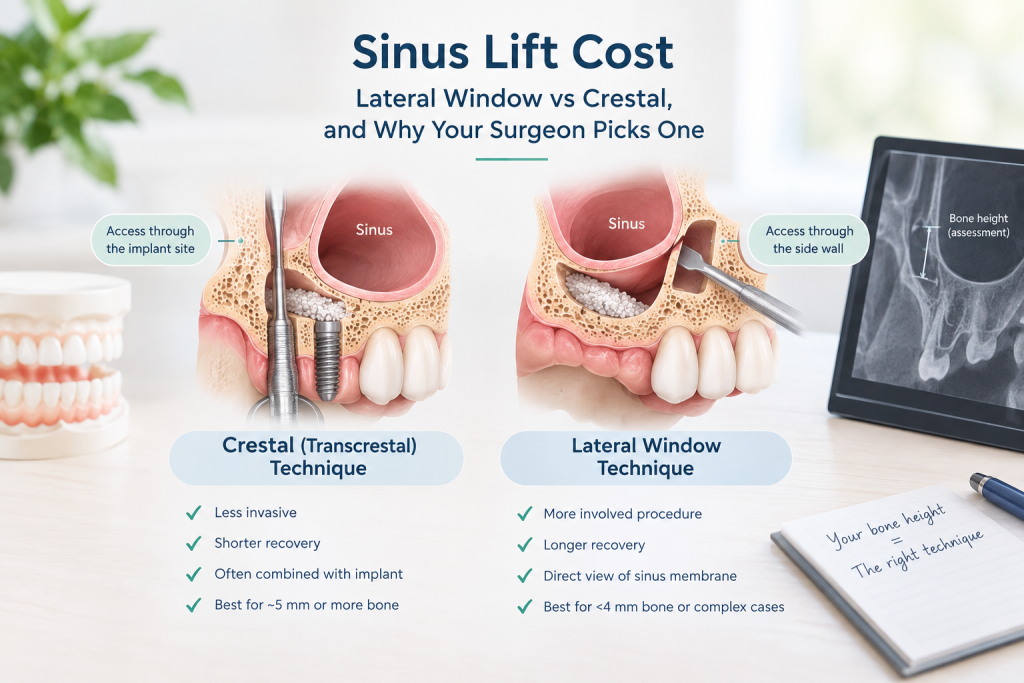
At a consultation for an upper back tooth implant, a patient sometimes hears a sentence that raises more questions than it answers: “You’ll need a sinus lift, and we’d do it through the crestal approach instead of the lateral window.” The two names describe genuinely different operations, with different invasiveness, different healing times, and a real gap in price. Neither one is simply the “better” choice. Which one applies to you comes down almost entirely to a single measurement your surgeon takes from your scan.
Quick Answer
A crestal (transcrestal) sinus lift typically costs $600 to $1,500 and is used when a reasonable amount of bone already remains. A lateral window sinus lift typically costs $2,000 to $4,000 or more per side and is used when very little bone remains or the case is more anatomically complex. The deciding factor is a measurement called residual bone height, not patient preference.
At a Glance
| Crestal (transcrestal) | Lateral window | |
|---|---|---|
| Typical cost, one side | $600 to $1,500 | $2,000 to $4,000+ |
| Bone height needed | Roughly 5 mm or more | Often used under about 4 mm |
| Invasiveness | Lower | Higher |
| Visibility of the sinus membrane | Limited | Direct |
| Can often combine with implant placement same day | Yes, frequently | Sometimes, depends on bone gain needed |
What a Sinus Lift Actually Does
After losing an upper back tooth, the bone beneath the sinus can shrink, and the sinus itself can expand downward into that space over time. If there isn’t enough bone left to anchor an implant securely, a surgeon lifts the floor of the sinus and packs bone graft material underneath it, creating room for the implant to sit in solid bone instead.
The Measurement That Decides Which Technique You Get
Surgeons call it residual bone height, the amount of your own bone remaining between the top of your jaw ridge and the floor of the sinus, measured from a CBCT scan. According to a clinical comparison published on Periospot, a dental implant education resource, 4 to 6 millimeters of remaining bone is something of a gray zone where either technique can apply depending on the health of the membrane, while thinner bone pushes the decision firmly toward a lateral window. A registered clinical trial comparing the two approaches puts it more simply: the lateral approach is generally used under about 5 millimeters of bone, while the crestal approach is used at 5 millimeters or more. Your own number, not a general preference, is what your surgeon is working from.
The Crestal (Transcrestal) Technique
This approach goes in through the same channel the implant itself will later use. The surgeon works from the top of the ridge, gently raising the sinus floor through a small access point, often with the implant placed in the same visit. It’s the less invasive option, with a faster recovery and typically less swelling than a lateral window procedure.
The classic version of this technique, introduced by Dr. Hilt Summers in 1994, uses a hand instrument called an osteotome, tapped gently with a mallet. Newer variations, including specially designed drills and a technique called osseodensification, have been developed partly to reduce two recognized complications of the original method: brief positional vertigo and headache from the tapping motion. Pearl’s national cost data puts a crestal sinus lift at $600 to $1,500.
The Lateral Window Technique
This approach, first described by Boyne and James, opens a small window through the side wall of the jawbone to reach the sinus directly. It gives the surgeon a clear, direct view of the sinus membrane, which matters when more bone needs to be added or the anatomy is more complicated, such as the presence of internal sinus walls (septa) or a thicker membrane. It’s a more involved procedure than the crestal approach, with a longer recovery, but it remains, according to the Dentalkart clinical review, the technique of choice when very little bone remains or when the case calls for substantial bone gain.
Pearl’s national cost data puts a lateral window sinus lift at $2,000 to $4,000 or more per side, and a Delta Dental Patient Direct fee schedule, effective November 2025, lists a contracted fee of $2,835 for the same procedure code, as reported by ThePricer. A contracted insurance fee sits below many cash-pay quotes, so treat it as a floor rather than an expectation.
Why the Lateral Window Costs More
The price gap tracks the surgery itself. A lateral window takes longer in the chair, involves raising a small flap of gum tissue and cutting a window in bone, and generally places and shapes more graft material to achieve a larger bone gain. A crestal lift works through a narrower, already-planned access point and is often finished in less time. More surgical time, more materials and a higher level of technical complexity add up to a higher fee, independent of which surgeon is doing the work.
Treating Both Sides
Needing a lift on both the left and right side isn’t unusual, and the price doesn’t simply double. Pearl’s data indicates a bilateral lateral window procedure typically costs 1.5 to 2 times the single-side price, since some surgical setup and facility costs are shared between both sides. On a $2,000 to $4,000 single-side range, that puts bilateral treatment at roughly $3,000 to $8,000, before any implants are added. This is a calculation based on Pearl’s own stated ratio, not a separately published bilateral figure, so treat it as a planning range.
Does Insurance Help?
Sometimes. Pearl notes that some dental plans cover a portion, commonly around 40 to 50 percent, of a sinus lift when it’s classified as medically necessary rather than purely elective. A graft performed only to prepare for an implant you’ve chosen electively is more often excluded. Ask your office to submit a pre-treatment estimate so you know your plan’s actual position before surgery, not after. Our dental implant insurance calculator can help you model different coverage scenarios.
How Long Before an Implant Can Go In
Timing varies by technique and by how much bone needs to form. A crestal lift combined with implant placement in the same visit is common when the bone gain needed is modest. A lateral window case, especially one needing significant bone gain, more often waits several months for the graft to mature, with published guidance commonly citing a range of about 4 to 9 months depending on the size of the graft and individual healing.
What Your Surgeon Is Actually Weighing
The choice isn’t a menu you pick from. It follows directly from your CBCT scan: how much bone remains, how healthy and thick the sinus membrane looks, whether a septum or other anatomical variation is present, and how much bone gain your implant plan actually requires. A surgeon recommending a lateral window on a thin-bone case isn’t upselling you. A surgeon recommending crestal on a healthier case isn’t cutting corners. Both are reading the same scan toward the technique that matches it.
See Your Own Numbers
Our sinus lift cost calculator lets you model either approach, and if a bone graft elsewhere in your mouth is also part of your plan, our bone graft cost by graft type guide breaks that down separately.
Frequently Asked Questions
Can I request the cheaper crestal option instead of a lateral window?
Not really. The choice follows your bone height and sinus anatomy, not preference. If your scan calls for a lateral window, a crestal approach may not safely achieve the bone gain your implant needs.
Is the crestal technique less effective than the lateral window?
No. Published survival rates for both approaches are high and broadly comparable when each is used on the case it’s suited for. Neither is a “lesser” version of the other.
What is the vertigo some patients mention with sinus lifts?
It’s a known, generally brief complication of the classic osteotome crestal technique, caused by the gentle tapping motion used to raise the sinus floor. Newer crestal methods, including specially designed drills and piezoelectric instruments, were developed partly to reduce this.
Can a sinus lift and implant be placed in the same visit?
Often with the crestal approach when the needed bone gain is modest. Lateral window cases more often require the graft to heal first, though this varies by case.
Does a bilateral sinus lift cost exactly twice the single-side price?
Usually somewhat less than a strict doubling, since some surgical and facility costs are shared between both sides.
The Bottom Line
Lateral window and crestal sinus lifts aren’t competing options with the same goal. They’re two different tools matched to two different situations, and the one your surgeon recommends follows directly from how much bone you have left. Confirm your residual bone height, ask which technique your plan calls for and why, and get a written, itemized quote before scheduling. Then use our sinus lift cost calculator to model your own numbers.
Sources: Pearl, Sinus Lift National Cost · Delta Dental Patient Direct fee schedule, effective November 2025, as reported by ThePricer · Periospot, Sinus Lift in Implant Dentistry · ClinicalTrials.gov, NCT06207578 · Dentalkart, Crestal vs. Lateral Sinus Lift