Full Mouth Dental Implants Cost: Three Prices Hiding Behind One Phrase
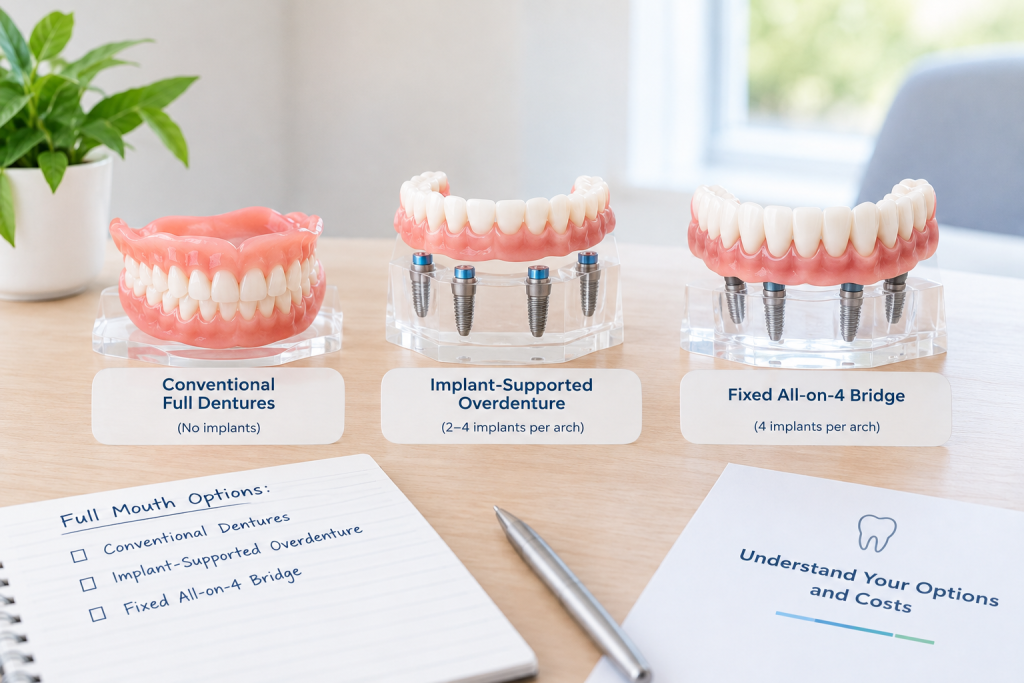
“Full mouth dental implants” sounds like a single treatment with a single price tag. It isn’t. The phrase actually covers at least three distinct approaches, a removable denture that snaps onto implants, a fixed bridge screwed onto four or six implants, or individual implants for every missing tooth, and the gap between the cheapest and most expensive of these can run past $50,000. Before you can talk about cost, you have to know which of the three you’re actually pricing.
Quick Answer
For one full arch (upper or lower, not both), a conventional removable denture averages around $1,968, an implant-supported overdenture averages around $8,289, and a fixed All-on-4 style bridge averages $15,176. Treating both arches roughly doubles each of these, landing around $4,000, $38,000 to $62,000, and $23,000 to $55,000 respectively, though the exact total depends heavily on materials and whether grafting is needed.
At a Glance: Three Approaches, Both Arches
| Approach | What it is | Typical cost, both arches |
|---|---|---|
| Conventional full dentures | Removable plate, no implants | $3,000 to $7,000 |
| Implant-supported overdenture | Removable denture that snaps onto 2 to 4 implants per arch | $38,000 to $62,000 |
| Fixed All-on-4 bridge | Non-removable bridge screwed onto 4 implants per arch | $23,000 to $55,000 |
What “Full Mouth” Actually Means
Two separate questions hide inside this phrase. The first is how many arches need treatment: some patients are missing teeth on top only, others on the bottom only, and others on both. The second is which prosthetic approach is used to replace them. A dentist quoting “full mouth implants” could mean either arch alone or both together, and could mean any of the three approaches below. Confirming both details before you compare quotes will save you from comparing numbers that aren’t actually describing the same treatment.
Approach One: Conventional Full Dentures
This is the only option on this list that doesn’t involve implants at all. A full denture is a removable plate that rests on the gums. It is by far the least expensive route and the fastest to deliver, but it also provides the least stability and the most noticeable change in chewing ability and fit over time.
CareCredit’s cost study puts the national average for a conventional full denture at $1,968 per arch, with a typical range of $1,520 to $3,648. Lower-cost versions run as low as $452, while premium, more natural-looking versions can exceed $6,500. Doubled for both arches, a mid-range set of conventional dentures typically lands between roughly $3,000 and $7,000.
Approach Two: Implant-Supported Overdentures
This is a middle ground. A small number of implants, usually 2 to 4 per arch, are placed in the jawbone, and a removable denture snaps onto them. The result is far more stable than a conventional denture, since it doesn’t rely on suction or adhesive, but it still comes out at night for cleaning, unlike a fixed bridge.
CareCredit’s cost and procedure guide puts this at an average of $8,289 per arch, with a typical range of $7,628 to $13,297. For both arches, that works out to roughly $38,000 to $62,000.
Approach Three: Fixed Full-Arch Bridges (All-on-4 and All-on-6)
This is the approach most people picture when they hear “full mouth implants.” Four implants, or six in the All-on-6 variation, are placed per arch and a non-removable bridge is screwed onto them, functioning much closer to natural teeth. It is the most expensive of the three and the most involved surgically, but it is also the most stable and the closest to a permanent solution.
CareCredit’s All-on-4 cost and procedure guide puts the national average at $15,176 per arch, with a typical range of $11,640 to $27,500. Doubling that for both arches gives a working range of roughly $23,000 to $55,000, and that is genuinely a calculation, not a separately published “both arches” figure, since many practices offer a modest discount for treating both arches in the same visit, which can bring a real quote in slightly under a strict doubling. All-on-6 adds two more implants per arch for extra support in cases with higher bite force or more bone loss, and commonly costs somewhat more than All-on-4 as a result, though we don’t have a single verified national figure for it the way we do for All-on-4.
A Fourth Option Worth Mentioning, Briefly
A small number of patients still choose an individual implant for every missing tooth rather than a full-arch bridge. This can mean 10 or more implants per arch instead of 4 to 6, which pushes the cost well past either option above, often into six figures for both arches combined. In practice, very few patients choose this route today, since a fixed full-arch bridge delivers a nearly identical functional result for a fraction of the cost and the surgery.
What Changes the Price Within Any of These Tiers
- Material. An acrylic bridge costs less than a zirconia one, which is more durable and more natural-looking but adds meaningfully to the price.
- Bone grafting. If your jawbone has shrunk since you lost your teeth, a graft or sinus lift is billed separately. Our bone graft cost by graft type guide breaks that cost down on its own.
- Extractions. If damaged teeth still need to come out before implants go in, that’s an additional line item.
- Sedation. Local anesthesia costs less than IV sedation or general anesthesia, and full-mouth cases more often call for one of the latter two.
- Where you live. Overhead and local market rates shift these numbers meaningfully from state to state. Our dental implant cost by state guide shows how much that alone can move a quote.
Which Approach Actually Fits Your Situation
A conventional denture makes the most sense when budget or timeline is the deciding factor and implants aren’t an option right now. An implant-supported overdenture is a common middle choice for patients who want real stability without committing to the highest price tier, or whose bone density makes a smaller number of implants the safer surgical choice. A fixed All-on-4 or All-on-6 bridge suits patients prioritizing a permanent, non-removable result and who are comfortable with the higher upfront cost and more involved surgery. None of these is objectively “better” outside the context of your own bone health, budget and priorities, which is exactly why this is a conversation for your consultation, not a decision to make from an article.
Insurance and Financing
Dental insurance rarely covers full-arch implant treatment in any meaningful way. Most plans were built around individual procedures, not a case of this size, and annual maximums are typically a small fraction of what any of these three approaches cost. Third-party financing, in-house payment plans, and HSA or FSA funds are the more realistic paths for most patients. Our dental implant financing calculator and dental implant insurance calculator let you model both before your consultation.
See Your Own Numbers
For a fixed full-arch estimate, try our All-on-4 cost calculator or All-on-6 cost calculator. For a broader look across treatment types, our full mouth dental implant cost calculator lets you compare scenarios side by side.
Frequently Asked Questions
Is an implant-supported overdenture the same as All-on-4?
No. An overdenture is removable and snaps onto a small number of implants. All-on-4 is fixed in place and only a dentist can remove it. They use a similar number of implants but deliver a very different day-to-day experience.
Why is All-on-6 usually more expensive than All-on-4?
It uses two additional implants per arch, which adds surgical and material cost. It’s often recommended for patients with higher bite force or more significant bone loss.
Does treating both arches always cost exactly double the one-arch price?
Not always. Some practices offer a modest discount for treating both arches in the same visit, since some surgical and facility costs are shared. Treat a strict doubling as a ceiling, not a guarantee.
Is a conventional denture ever the right choice over implants?
It can be, particularly when cost, timeline, or a patient’s bone health make implants impractical right now. It’s a legitimate option, not simply a lesser one, for the right situation.
Will insurance cover any part of a full-arch case?
Rarely in a meaningful way. Most dental plans weren’t designed around treatment at this scale. Confirm your specific annual maximum and any major-procedure waiting period before assuming any particular level of coverage.
What’s the single biggest factor in the final price?
Which of the three approaches you choose affects the total far more than almost any other single factor, including material choice within a given approach.
The Bottom Line
“Full mouth dental implants” isn’t one price, it’s three different treatments wearing the same name. A conventional denture, an implant-supported overdenture, and a fixed All-on-4 or All-on-6 bridge sit at three very different price points for a reason: they deliver three different levels of stability, permanence and day-to-day function. Identify which one you’re actually being quoted, confirm whether it covers one arch or both, and then use our dental implants cost calculator to model your own numbers before your consultation.
Sources: CareCredit, Dental Implants Cost and Procedure Guide and All-on-4 Dental Implant Cost and Procedure Guide, 2024 Synchrony Average Procedural Cost Study, ASQ360° Market Research · Denture cost figures as independently reported by The Senior List, citing the same CareCredit study.