Dental Implants Without Insurance: What You’ll Pay and How to Lower It
| Dr.Mike, BDS, MDS – Dentist & Oral Health Specialist |
More than one in five adults in the United States has no dental insurance at all, and most plans that do exist were never built around covering an implant in the first place. If you are one of them, the sticker price of an implant can feel like a wall rather than a treatment plan. It doesn’t have to be. There is a real difference between the advertised price and what patients without coverage actually end up paying once they know where the flexibility is.
Quick Answer
Without insurance, a single tooth implant typically costs $3,000 to $6,000 in the United States, covering the post, abutment and crown. Full-arch and full-mouth treatment costs considerably more. Dental school clinics, HSA or FSA funds, third-party financing and direct discount plans are the main legitimate ways to bring that number down, often by 25 to 60 percent depending on the route you choose.
At a Glance
| Treatment | Typical cost without insurance |
| Single tooth implant (post, abutment, crown) | $3,000 to $6,000 |
| Implant-supported bridge (multiple teeth) | $6,000 to $15,000 |
| All-on-4 or All-on-6, per arch | $20,000 to $35,000 |
| Full mouth, both arches | $40,000 to $90,000+ |
Full-arch and full-mouth figures vary widely by publisher and by region, far more than single-tooth figures do, so treat the bottom two rows as a starting point for research rather than a firm number. Get written quotes before budgeting around any of these.
Why Insurance Often Doesn’t Help Much Here
According to the American Dental Association’s Health Policy Institute, 21.8 percent of adults in the U.S. had no dental insurance at all as of 2022, and the rate has been higher in past years. Even patients who do have a plan often find implants fall outside it. Many dental policies still classify implants as a major or elective procedure, apply a waiting period before paying anything toward them, or cap annual benefits low enough that the payout barely dents a real bill. That combination is exactly why “without insurance” describes a much larger group of patients than the uninsured alone.
Uninsured-adult figure: American Dental Association Health Policy Institute data, as reported by Becker’s Dental Review.
What You’re Actually Paying For
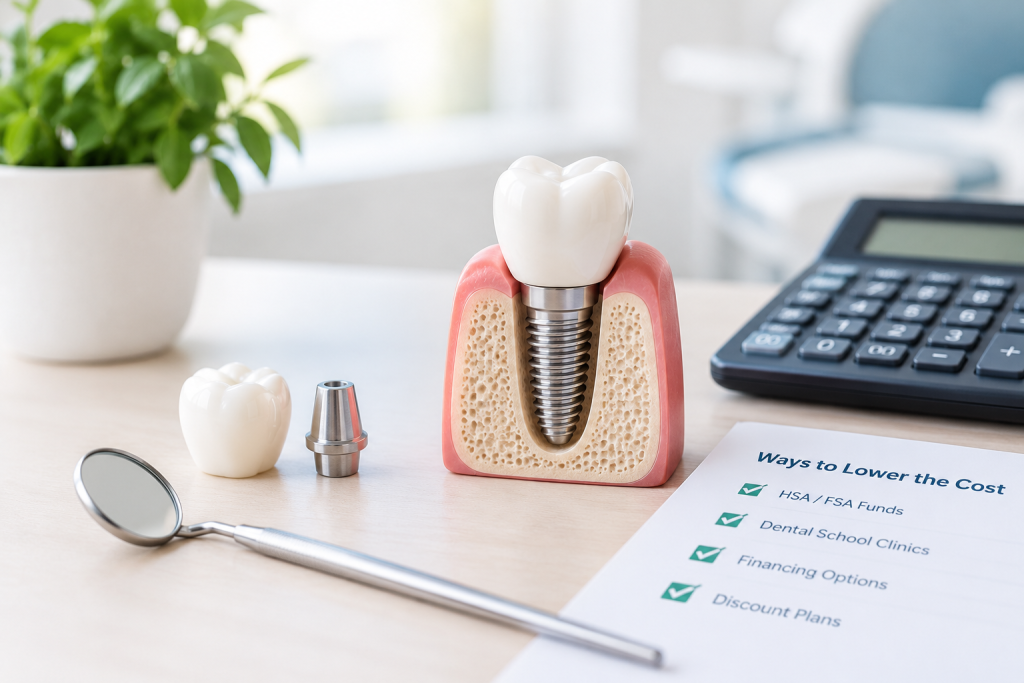
A single implant has three parts, and each one adds to the bill: the titanium post placed in the jawbone, the abutment that connects it to the visible tooth, and the crown itself. Some practices quote these as one bundled number. Others separate the surgical fee from the restorative fee, which is one reason two cash-pay quotes for the same tooth can look very different even before any discount is applied. Ask for an itemized breakdown before comparing prices between offices.
If your case also needs a bone graft or sinus lift first, that is billed on top of the implant, not included in it. Our bone graft cost by graft type guide breaks that part down separately.
Six Ways to Lower the Bill Without Insurance
- HSA or FSA funds. Dental implants are an IRS-qualified medical expense, which means Health Savings Account or Flexible Spending Account dollars can usually be applied directly to the cost. Because these are pre-tax dollars, this is often the simplest way to reduce your effective cost without changing anything about your treatment. Confirm your specific plan’s rules with your administrator, since FSA funds in particular can carry a use-it-or-lose-it deadline.
- Dental school clinics. Treatment performed by supervised dental students, under the direct oversight of licensed faculty, is one of the largest legitimate discounts available. UCSF Dental Center reports that care from student dentists costs 40 to 60 percent less than a private practice, while treatment in a resident or specialty clinic runs about 25 percent less. Wichita State University’s dental practice publishes a direct example: implants priced at $3,500 for its student discount program against $4,500 to $6,000 at local private practices. The trade-off is time, since appointments run longer and the schedule depends on an academic calendar.
- Third-party healthcare financing. Companies such as CareCredit offer credit specifically for medical and dental expenses, sometimes with promotional no-interest periods. Read the terms carefully, since deferred-interest plans can charge interest retroactively from the purchase date if the balance isn’t paid in full by the promotional deadline.
- In-house payment plans. Many implant practices will split a bill into installments directly, without involving a lender at all. This won’t lower the total cost, but it spreads it out, and some offices offer a small discount for paying in full up front instead.
- Dental discount or membership plans. These are not insurance. For an annual membership fee, participating dentists agree to a reduced cash rate, commonly in the 10 to 30 percent range, on most procedures including implants. They work best when you already have a dentist in the network you trust.
- Community health centers and nonprofit clinics. Federally qualified health centers and some nonprofit dental clinics offer sliding-scale fees based on income. Availability and the range of services, including whether implants are offered at all, vary a great deal by location, so this is worth a phone call rather than an assumption either way.
A Word on Dental Tourism
Traveling abroad for lower-cost implant treatment is a real option some patients consider, and prices at international clinics can look dramatically lower on paper. It deserves its own careful look at follow-up care, warranty terms and travel costs rather than a quick summary here, so we’ve covered it separately in our guide to dental implants abroad versus the U.S.
Building a No-Insurance Budget
- Get a written, itemized quote from at least two providers before comparing any numbers.
- Ask directly whether a bone graft or sinus lift is likely. This is the most common reason a quoted price and a final bill don’t match.
- Check your HSA or FSA balance before looking at financing, since it is the lowest-cost source of funds you already have.
- Call a local dental school even if you don’t end up using it, just to have a real comparison number.
- Compare the total cost of financing, not the monthly payment. A lower monthly figure over a longer term can cost more overall.
- Build in a buffer of 10 to 15 percent for imaging, medication or a follow-up visit that wasn’t in the original plan.
Mistakes Worth Avoiding
A quote with no imaging behind it isn’t a real estimate yet. The cheapest number on paper sometimes excludes the crown or a needed graft, which shows up later as a surprise. And a provider who pressures you to book before you’ve seen a written plan is a reason to pause, not proceed, regardless of the price.
Model Your Own Numbers
Our dental implant financing calculator lets you compare monthly payments across different terms, and our dental implant insurance calculator shows how a partial benefit, if you have one, changes your out-of-pocket total. For full-arch planning specifically, see our full mouth dental implant cost calculator.
Frequently Asked Questions
Can I use my HSA or FSA for a dental implant?
In most cases, yes, since implants are an IRS-qualified medical expense. Confirm your specific plan’s rules, especially any deadline on FSA funds, with your plan administrator.
Are dental school implants lower quality?
No. Treatment is performed under direct supervision by licensed faculty, and schools are a recognized route for lower-cost care. The trade-off is time, not quality.
Is a dental discount plan the same as dental insurance?
No. A discount plan gives you a reduced cash rate at participating providers for an annual fee. It never pays a claim on your behalf the way insurance does.
What’s the biggest hidden cost patients without insurance miss?
A bone graft or sinus lift that wasn’t in the original quote. Ask specifically whether your case is likely to need either before you compare prices.
Does a lower monthly payment always mean a better financing deal?
No. A longer term can lower the monthly payment while raising the total amount paid. Compare the full repayment cost, not just the monthly figure.
Is it ever worth paying full price instead of chasing every discount?
Sometimes. If a provider’s experience, technology or convenience genuinely matters to your case, it can be a reasonable trade-off. The goal is an informed choice, not automatically the lowest number.
The Bottom Line
Going without insurance doesn’t mean paying the sticker price. HSA and FSA funds, dental school clinics, direct discount plans and carefully compared financing can each reduce the real cost of an implant, often substantially, without lowering the standard of care. Start with a written, itemized quote, then use our dental implants cost calculator to model your specific scenario before your consultation.
Sources
American Dental Association Health Policy Institute data, as reported by Becker’s Dental Review · UCSF Dental Center, Patient FAQ · Wichita State University, Shocker Student Dental Discount Program