
Hyperdontia: Why Some People Grow Extra Teeth, and Why It’s Sometimes Found Decades Later
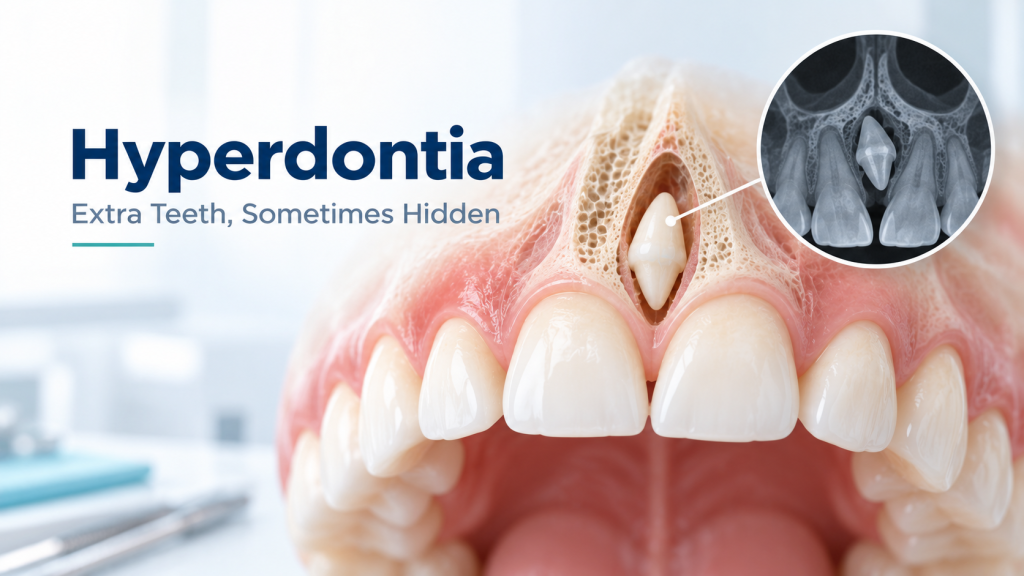
A patient in their fifties once came in for a routine CBCT scan ahead of implant planning, nowhere near the area we were actually investigating, and the scan turned up a small, cone-shaped tooth that had been sitting buried in their jaw their entire life. They’d never had symptoms. Never known it was there. It had simply stayed quiet in the bone for over five decades until an unrelated scan happened to catch it. That’s a far more common story than most people realize: hyperdontia is often entirely silent, and it’s frequently discovered by accident, not because anything was wrong.
Quick Answer
Hyperdontia is the presence of one or more extra teeth beyond the usual 20 primary or 32 permanent teeth, called supernumerary teeth. It affects roughly 0.1 to 3.8 percent of people in their permanent teeth and is about twice as common in men. Most cases involve a single extra tooth that never erupts and causes no symptoms, which is why it’s so often found incidentally on an X-ray or CBCT scan taken for an entirely different reason.
At a Glance
| Detail | |
|---|---|
| Prevalence, permanent teeth | 0.1% to 3.8% |
| Prevalence, baby teeth | 0.3% to 0.6% |
| Sex ratio | About 2 to 1, male to female |
| Most common type | Mesiodens (between the upper front teeth) |
| Most cases involve | A single extra tooth |
| How it’s usually found | Incidentally, on a routine X-ray or CBCT scan |
What’s Actually Happening
Hyperdontia means your tooth buds formed one or more extra teeth beyond the standard count, and these extras are called supernumerary teeth. The most common single type by far is the mesiodens, a small, often cone-shaped tooth that forms in the midline of the upper jaw, between or behind the two front teeth. Fourth molars, extra premolars, and duplicated lateral incisors show up too, just less often. Most people with hyperdontia have exactly one extra tooth. Having five or more is genuinely rare, reported in under 1 percent of hyperdontia cases overall.
Why It Happens
The honest answer is that the precise trigger isn’t fully understood, but genetics clearly plays the lead role. Researchers have traced specific genetic mechanisms behind the conditions most strongly associated with multiple extra teeth: cleidocranial dysplasia has been mapped to mutations in the RUNX2 gene on chromosome 6p21, and Gardner syndrome, a form of familial adenomatous polyposis, is caused by mutations in the APC gene. Cleft lip and palate and Ehlers-Danlos syndrome are also well-documented associations. That said, the large majority of people with a single extra tooth have none of these conditions. It’s simply a developmental variation, sometimes one that runs quietly in families without a diagnosed syndrome attached to it at all.
The Adult Discovery That Rarely Gets Discussed
Most articles on this topic focus on children, and for good reason, since a mesiodens blocking the front teeth is usually caught early in a child’s dental visits. What gets talked about far less is how often an extra tooth surfaces in adulthood, purely by accident, often during imaging taken for a completely unrelated reason. A CBCT scan done to plan a dental implant, map out a bone graft, or investigate an impacted wisdom tooth will capture the entire jaw, not just the area of interest, and that’s exactly how a lifelong, symptom-free extra tooth frequently gets discovered for the first time, sometimes in a patient’s forties, fifties, or later. If this happens to you, it doesn’t necessarily mean anything needs to be done. It means your dentist now has the information to decide whether it should be.
When It’s Left Alone, and When It’s Removed
The decision comes down to what the extra tooth is actually doing, not the mere fact that it exists. An extra tooth that’s fully erupted, easy to clean, and not crowding or displacing anything nearby can often simply be monitored with periodic imaging. Removal becomes the standard recommendation when the extra tooth is blocking a normal tooth from erupting, which is the classic reason a childhood mesiodens gets taken out, when it’s pushing neighboring teeth out of alignment or creating a gap, when it’s making an area difficult to clean properly, raising decay and gum disease risk, or when imaging shows a cyst forming around an impacted one, which happens in a minority of cases but is worth catching early.
If Removal Overlaps With Implant Planning
Here’s where this topic can intersect directly with restorative treatment. If an extra tooth is discovered during implant planning imaging and happens to sit in or near the area where an implant is going, your treatment sequence may need to account for both: removing the supernumerary tooth, allowing adequate healing time at that site, and then proceeding with implant placement once the bone has settled. This isn’t a complication in the sense of something going wrong. It’s simply additional information your surgeon now has before finalizing the plan. Our dental implants cost guide covers how an extraction and healing period typically factor into an overall implant timeline and cost.
What This Looks Like for Your Child
Extra teeth are often first noticed in childhood specifically because a permanent tooth is slow to erupt, or the front teeth develop an unexpected gap. Because an impacted mesiodens can genuinely block the adult front incisors from coming in properly, routine pediatric dental visits with periodic imaging remain the most reliable way to catch this at the point where early removal still allows the normal teeth to erupt on their own, without more involved orthodontic correction later.
Frequently Asked Questions
Is an extra tooth dangerous if it’s never caused a problem?
Not inherently. Many extra teeth sit quietly for a lifetime without causing issues. The reason dentists still recommend evaluating one is to rule out the less common scenarios, like cyst formation or hidden crowding, that only imaging can reveal.
Why would an extra tooth only be found in adulthood instead of childhood?
If it never erupts and never causes crowding, pain, or a noticeable gap, there’s simply nothing to prompt earlier imaging specifically of that area. It often takes an unrelated scan, such as one done before a dental implant, to bring it to light.
Does having one extra tooth mean I should be checked for a genetic syndrome?
Not generally. A single extra tooth with no other symptoms is usually an isolated developmental variation. Multiple extra teeth, especially alongside other symptoms, is what tends to prompt a broader evaluation for an underlying condition.
Can an extra tooth be used instead of removed?
Occasionally, if it’s well-positioned and healthy, a supernumerary tooth can sometimes be incorporated into the bite rather than extracted, though this is decided case by case and is less common than removal.
Is removal of an extra tooth a complicated procedure?
It varies by location and whether the tooth is impacted or already erupted. An erupted extra tooth is often a straightforward extraction, while an impacted one, particularly one associated with a cyst, may involve a more involved surgical approach.
Will removing an extra tooth affect a dental implant planned nearby?
It can affect timing. If the extra tooth sits at or near a planned implant site, your surgeon will typically want the area to heal after extraction before placing the implant, which may add time to the overall treatment plan.
The Bottom Line
Hyperdontia is more common, and more often silent, than most people assume, affecting up to roughly 1 in 25 people in some studies, with a single extra tooth being the typical presentation rather than the exception. Whether it needs treatment depends entirely on what that tooth is actually doing to your bite, your bone, and your ability to keep the area clean, not on the fact that it’s there at all. If one turns up on your own imaging, whether during a routine exam or while planning something like an implant, that’s a conversation worth having with your dentist rather than a cause for concern on its own.
Sources: Genetics of non-syndromic supernumerary teeth, PMC · Prevalence of hyperdontia in a nonsyndromic population, PMC · Characteristics of nonsyndromic supernumerary teeth in children and adolescents, Turkish Journal of Medical Sciences